Wetang’ula defends Nzoia Sugar privatisation, cites faster cane payments
By Faith Lagat, February 1, 2026National Assembly Speaker Moses Wetang’ula has defended the privatisation of Nzoia Sugar Company, saying the decision has already led to faster and more reliable payments to farmers delivering cane to the mill.
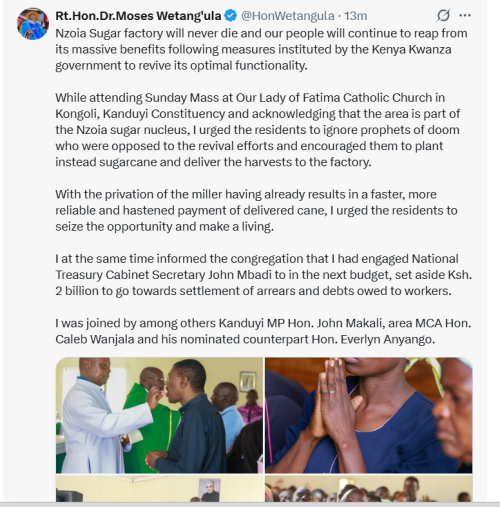
Speaking during Sunday Mass at Our Lady of Fatima Catholic Church in Kongoli, Kanduyi Constituency, on February 1, 2026, Wetang’ula described the region as part of the Nzoia sugar nucleus and urged residents to ignore critics opposed to the leasing arrangement.
“Nzoia Sugar factory will never die and our people will continue to reap from its massive benefits following measures instituted by the Kenya Kwanza government to revive its optimal functionality,” Wetang’ula told the congregation.
He encouraged farmers to increase cane production and supply to the factory, noting that the leasing of the miller had already improved payment timelines.
“With the privatisation of the miller having already resulted in a faster, more reliable and hastened payment of delivered cane, I urged the residents to seize the opportunity and make a living,” he said in a post on X.
Government funding and factory overhaul
Wetang’ula further revealed that he had engaged National Treasury Cabinet Secretary John Mbadi to allocate Ksh 2 billion in the upcoming budget to clear outstanding arrears and debts owed to workers at the factory.
Nzoia Sugar Company was leased to West Kenya Sugar Company, owned by businessman Jaswant Singh Rai, for a 30-year period, under an agreement that provides for all investments to revert to the government at the end of the lease.
Principal Secretary for Trade and Investments Juma Mukhwana, speaking in an interview on October 11, 2025, explained that the factory’s full revival could take up to three years due to severely outdated machinery.
Established in 1976, the plant had deteriorated significantly, with efficiency dropping to about 10 per cent, leading to frequent breakdowns and substantial sugar losses.
Mukhwana said modern machinery had been imported from India and engineers brought in to rehabilitate the facility, with efficiency expected to rise to between 80 and 100 per cent once upgrades are complete.
Opposition protests and job losses
The PS also addressed concerns over recent retrenchments, saying the factory had previously employed more than 6,000 workers for operations that required about 400 staff, placing strain on finances and undermining profitability.
He criticised leaders opposing the lease arrangement, accusing them of prioritising political interests over the welfare of farmers and workers.
His remarks followed protests by Western region opposition leaders, including DAP-K leader Eugene Wamalwa, Trans Nzoia Governor George Natembeya, DAP-K deputy leader Cleophas Malala, Kabuchai MP Majimbo Kalasinga, and Bumula MP Jack Wamboka.
Despite the opposition, Wetang’ula maintained that the government’s intervention would restore the factory’s viability and deliver long-term benefits to farmers and workers across Bungoma and neighbouring counties.