Venezuela’s government and opposition may coordinate to protect US oil assets
By Reuters, April 7, 2026Venezuela’s government and its political opposition are seeking to coordinate their legal defense of the oil-rich country’s United States assets, after Washington’s official recognition of interim President Delcy Rodriguez raised questions about who could represent the country in U.S. courts.
Lawyers for Rodriguez’s government and the opposition asked Manhattan-based U.S. Magistrate Judge Sarah Netburn on Monday to pause for 45 days a case in which creditors are seeking to seize funds linked to state oil company Petroleos de Venezuela (PDVSA.UL) while they determined who would represent Venezuela’s interests.
Why the pause matters
The letter signaled potential cooperation between the opposition and Rodriguez’s government in the safeguarding of U.S. assets including Houston-based oil refiner Citgo Petroleum (PDVSAC.UL) from creditors, including holders of debt issued by PDVSA and Venezuela’s government, companies whose Venezuelan assets were expropriated, and victims of acts of alleged terrorism.
Venezuela’s information ministry, which handles media requests on the government’s behalf, did not immediately respond to a request for comment.
Political context and recognition by Washington
Relations between the opposition and Venezuela’s socialist government have long been acrimonious. The opposition has controlled U.S. assets including Citgo since 2019, when Washington first imposed sanctions on PDVSA in a bid to pressure now-jailed President Nicolas Maduro to leave office.
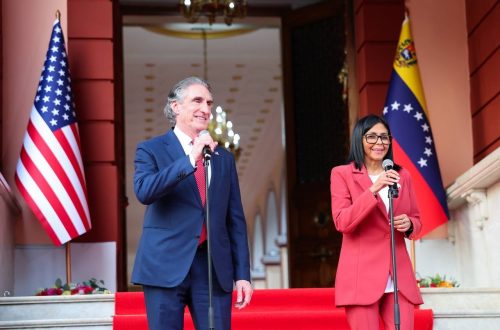
Washington in March recognized Rodriguez as Venezuela’s leader, following the capture of Maduro by U.S. forces. She is now preparing to take over the boards of PDVSA’s U.S. subsidiaries including Citgo, Reuters reported on April 1, citing four people close to the preparations.
The U.S. recognition of Rodriguez’s government prompted Netburn to ask the parties to the lawsuit to clarify who had authority to represent Venezuela in court.
Netburn on Monday granted the request to pause the case. Lawyers for the government and opposition are expected to update her on the selection of a lawyer to permanently represent Venezuela’s interests by May 21.
This comes as a unit of India’s refiner Reliance Industries has begun loading a 2-million-barrel cargo of Venezuelan heavy crude directly bought from state-run energy company PDVSA, according to a company document and shipping data on Monday.
Since Caracas signed a flagship oil supply deal with Washington after the U.S. capture of President Nicolas Maduro in January, only a small group of companies have been able to buy cargoes directly from PDVSA.
Oil proceeds from any sales remain controlled by the United States through bank accounts administered by the Treasury Department, and commercial terms must follow U.S. guidance, according to U.S. licenses granted for the trade so far.
On Monday, the Bahamas-flagged supertanker Helios, chartered by Reliance’s unit RIL USA, docked at PDVSA’s Jose terminal on Venezuela’s eastern coast and began loading its cargo of Merey heavy crude bound for India’s Sikka port, according to the document and ship tracking data from LSEG.
Reliance and PDVSA did not immediately reply to requests for comment.
Venezuela’s crude exports to India, which resumed in late February after a 10-month pause through sales made by U.S. oil company Chevron (CVX.N), opens new tab and trading houses Vitol and Trafigura to several Indian refiners, have helped drain millions of barrels of oil inventories in recent weeks, the shipping data showed.
The supertankers bound for India also are helping load cargoes faster at Jose, the country’s main oil port, accelerating overall crude exports.
Venezuela’s oil exports to India rose to some 342,000 barrels per day (bpd) in March, from 35,000 bpd in February, according to vessel tracking data.