US restores AGOA with one-year renewal to December 2026
By Kenneth Mwenda, February 5, 2026President Donald Trump has signed a law extending the African Growth and Opportunity Act (AGOA) by one year, keeping the trade programme alive until December 31, 2026.
The extension applies retroactively from September 30, 2025, when AGOA expired. The move restores duty-free access to the United States market for eligible sub-Saharan African countries after months of uncertainty for exporters and governments.
US Trade Representative Jamieson Greer announced the decision on February 3, 2026. In a statement from the Office of the United States Trade Representative (USTR), Greer said the programme must now deliver more for American interests.
“AGOA for the 21st century must demand more from our trading partners and yield more market access for U.S. businesses, farmers, and ranchers to build upon the benefits it has historically provided to Africa and the United States,” Greer said.
He added that the administration would push for changes to the scheme over the next year.
“We must also make sure that the program enhances U.S.-Africa trade and will work with Congress over the next year to modernize the program to align with President Trump’s America First Trade Policy,” Greer said.
Congress passed the extension as part of a wider legislative package. The House of Representatives initially approved a three-year renewal, but the Senate reduced it to a single year. The House later accepted the amendment, clearing the way for Trump to sign it into law.
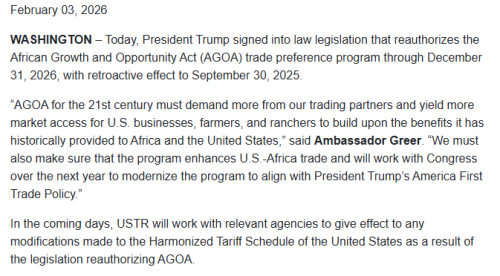
In the coming days, the USTR will work with other federal agencies to update the US Harmonized Tariff Schedule and implement any changes required under the new legislation.
AGOA benefits and rules
AGOA, first introduced in 2000, allows eligible sub-Saharan African countries to export more than 1,800 products to the US without paying duties. These benefits come on top of the over 5,000 products already covered under the Generalized System of Preferences.
According to data from the US International Trade Commission, exports under AGOA reached Ksh1 trillion in 2024. South Africa accounted for around half of that figure, while Nigeria contributed roughly one-fifth.
To qualify for AGOA, countries must demonstrate progress towards a market-based economy, respect for the rule of law, political pluralism and due process. They must also remove barriers to US trade and investment, adopt policies to reduce poverty, tackle corruption and protect human rights.
The lapse of the programme in September 2025 disrupted trade flows across the continent. Exporters faced the prospect of new tariffs, placing factories, supply chains and thousands of jobs at risk. Many businesses had built their operations around duty-free access to the US market.
While the extension prevents immediate economic disruption, it offers only short-term certainty. African businesses and governments have long pushed for longer renewals, arguing that investment and planning require predictable trade rules.