US issues travel advisory to 13 countries amid Gulf region tensions
By Aloys Michael, March 2, 2026The United States (US) has updated its travel advisory for citizens in parts of the Middle East, including Egypt, amid rising tensions between the US and Israel on one side and Iran on the other.
On Monday, March 2, 2026, the US Department of State Consular Affairs warned that Americans should exercise heightened caution when travelling to Egypt, Jordan, Oman, Saudi Arabia, and the United Arab Emirates, as these countries face potential threats from Iranian missile attacks.
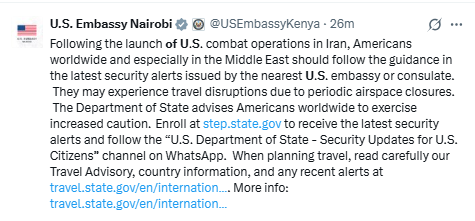
“Following the launch of U.S. combat operations in Iran, Americans worldwide and especially in the Middle East should follow the guidance in the latest security alerts issued by the nearest U.S. embassy or consulate. They may experience travel disruptions due to periodic airspace closures. The Department of State advises Americans worldwide to exercise increased caution,” the advisory read.
The advisory comes amid heightened regional tensions following recent strikes in parts of the Middle East, which have prompted the U.S. government to caution its citizens to take safety measures seriously.
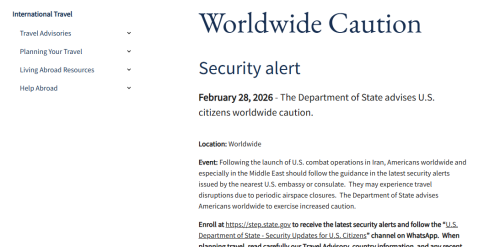
The US government urged its citizens to ensure that they follow up on developments happening in the Middle East Region through government websites and get in touch with the U.S. government in case they need consular help.
US citizens have also been advised to reconsider travelling to countries such as Bahrain, Israel, Kuwait, Pakistan, and Qatar.
The department has indicated that U.S. citizens should not travel to Iran, Iraq, and Lebanon, which are bearing the brunt of the ongoing missile strikes.
“The Trump Administration has no higher priority than the safety and security of Americans everywhere. Here is a brief summary of our latest security guidance for Americans in the Middle East as of March 1, 4 pm EST.”
The warning comes after the U.S. and Israel launched an attack on February 28, 2026, against strategic targets in Tehran, which prompted Iran to begin retaliatory attacks.
Meanwhile, the United Arab Emirates (UAE) Ministry of Defence reported that Iran launched 165 ballistic missiles, 2 cruise missiles, and 541 drones at its territory. While the majority were intercepted, 35 drones and several ballistic missile impacts were reported in vital infrastructure such as the Dubai International Airport, Abu Dhabi’s Zayed International Airport, and the Burj Al Arab.
On the other hand, Qatar’s Interior Ministry stated that 66 missiles and 12 drones were launched at the country. Most were intercepted, but shrapnel and impacts were reported in industrial zones in Doha.
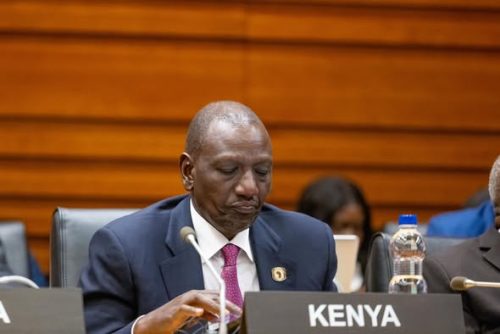
Ruto condemns attack
In a statement on Monday, March 2, 2026, President William Ruto condemned the recent strikes targeting Gulf countries, cautioning that they threaten to compromise international security and peace.
Ruto singled out attacks on the United Arab Emirates, Qatar, Saudi Arabia, Iraq, Oman, Kuwait, Jordan, and Bahrain by Iran, where over 400 Kenyans are living and working.
“It is evident that the regionalisation of this conflict poses a grave threat to international peace and security,” Ruto stated.
“At this defining and perilous moment in global history, longstanding multilateral institutions remain indispensable frameworks for the resolution of the current crisis in the Middle East,” he added.