US funding shift puts Kenya’s HIV achievements at risk – Duale warns
By Kiprono Keileb, September 25, 2025Health Cabinet Secretary Aden Duale has cautioned that Kenya’s hard-won gains in the fight against HIV could stall without sustainable funding as the United States shifts its global health priorities.
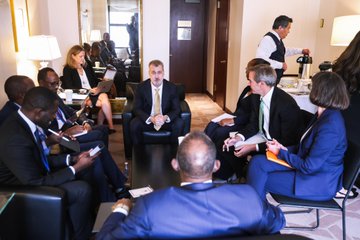
Speaking in New York on the sidelines of the 80th United Nations General Assembly on Thursday, September 25, 2025, Duale said Kenya and the US have enjoyed nearly two decades of strong collaboration through initiatives such as the President’s Emergency Plan for AIDS Relief (PEPFAR) and the President’s Malaria Initiative (PMI).
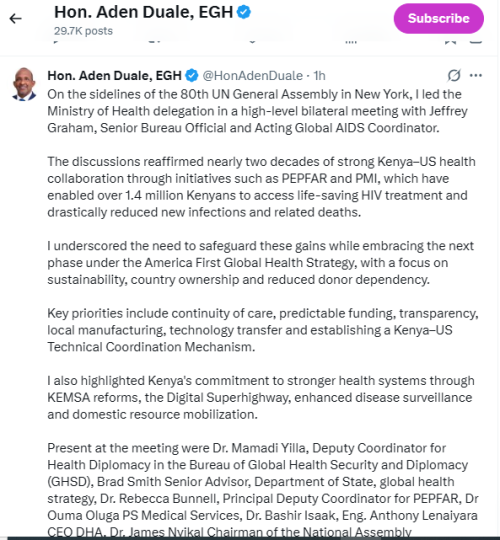
“The discussions reaffirmed nearly two decades of strong Kenya–US health collaboration through initiatives such as PEPFAR and PMI, which have enabled over 1.4 million Kenyans to access life-saving HIV treatment and drastically reduced new infections and related deaths,” he said after meeting Jeffrey Graham, the Acting Global AIDS Coordinator.
This comes after the Principal Secretary for Medical Services at Kenya’s Ministry of Health, Dr Ouma Oluga, had raised concern over the rise in new HIV infections in the country.
Duale also warned that while these milestones are significant, Kenya must prepare for a future where donor dependency is reduced.
“I underscored the need to safeguard these gains while embracing the next phase under the America First Global Health Strategy, with a focus on sustainability, country ownership and reduced donor dependency,” he stated.
He outlined key priorities that Kenya would focus on to maintain progress, including continuity of care for patients, predictable funding mechanisms, and transparency in the management of resources.
“Key priorities include continuity of care, predictable funding, transparency, local manufacturing, technology transfer and establishing a Kenya–US Technical Coordination Mechanism,” Duale explained.
The CS further highlighted steps the government is taking to strengthen local systems in line with these priorities. He pointed to reforms at the Kenya Medical Supplies Authority (KEMSA), investment in the Digital Superhighway, and enhanced disease surveillance as critical components of Kenya’s health agenda.
“I also highlighted Kenya’s commitment to stronger health systems through KEMSA reforms, the Digital Superhighway, enhanced disease surveillance and domestic resource mobilisation,” he said.
The meeting with US officials comes at a time when global health funding is shifting toward sustainability and local ownership, raising concerns for African countries that have long relied on international support to tackle epidemics such as HIV.