Treasury pushes Infrastructure Fund as critics warn of risks
By Kenneth Mwenda, February 15, 2026Kenya’s National Treasury has tabled the National Infrastructure Fund Bill, 2026, setting the stage for a fresh debate on how the country will finance major projects. The proposal, now before Parliament, seeks to establish a new fund to invest in roads, railways, ports, energy and water schemes while attracting private capital.
“The National Infrastructure Fund Bill, 2026, has been released. Read the Bill on @NAssemblyKE website,” Treasury wrote in a post on X, sharing a link to the document.
The Bill appeared in the Kenya Gazette on January 23, 2026 as National Assembly Bills No. 1. Leader of Majority Kimani Ichung’wah sponsored it in the National Assembly.
Treasury presents the Bill as a new way to finance major projects. It proposes a National Infrastructure Fund to invest in highways, railways, ports, power plants and water schemes.
The aim, according to Clause 4, is to scale up and accelerate development of catalytic national infrastructure and to reduce the reliance of public debt for the financing of commercial viable infrastructure investments.
In simple terms, the government wants to use private capital alongside public money. The Fund would draw in pension funds, sovereign wealth funds and climate finance. It would also use proceeds from privatisation and funds approved by Parliament.
On paper, this could ease pressure on public debt. Kenya has borrowed heavily for infrastructure over the past decade. Treasury argues that the new Fund will support commercially viable projects without adding to the debt burden.
Reality looks different. The Cabinet Secretary responsible for the National Treasury holds the real power.
Clause 2 defines “Cabinet Secretary” as the Cabinet Secretary for the time being responsible for the National Treasury. Clause 6(3) states plainly:
“The directors shall be appointed by Cabinet Secretary by notice in the Gazette.”
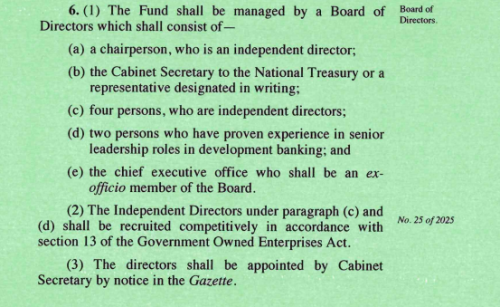
This covers the entire board: a chairperson (independent), four independent directors, two with development banking experience, plus the CEO as ex-officio member. Clause 6(2) requires competitive recruitment for some independents under the Government Owned Enterprises Act, but the Cabinet Secretary still appoints them all.
The board can invest in equity or debt, acquire property, hold securities, enter contracts, and act as agent for government agencies (Clause 12). Funds flow from privatisation sales, parliamentary appropriations, fees, donations, and loans (Clause 29).
Guarantees without safeguards
Government support comes easy: the Cabinet Secretary can issue binding undertakings, letters of support, credit guarantees, partial risk guarantees, or political risk insurance (Clause 25). These tools lower premiums factored for the profiling of political risks or underwrite commercial risks.
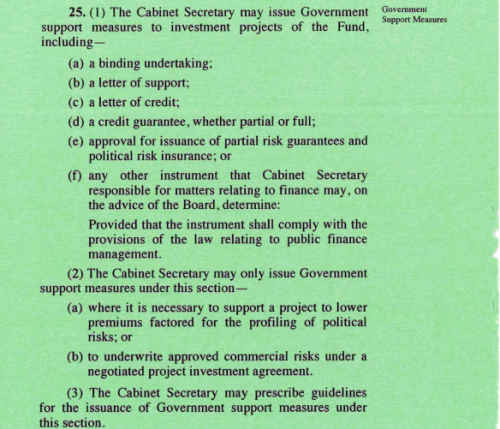
Oversight stays inside the executive circle. The Cabinet Secretary signs performance contracts with the board (Clause 19), evaluates the fund’s performance (Clause 20), and sets incentives.
The same Cabinet Secretary makes regulations on investment policy, standards, procedures, and government support measures (Clause 37):
“The Cabinet Secretary may make regulations generally for the better carrying into effect of the provisions of this Act.”
Reports go first to the Cabinet Secretary, then parliament (Clause 26), with disclosures posted on the Treasury website (Clause 27).
Kenya’s history of scandals – Anglo-Leasing, NYS, Arror and Kimwarer dams, stalled SGR extensions – shows what happens when Treasury controls big money pots with weak checks. This bill risks the same: public assets sold off to seed the fund, then funnelled to connected projects with government guarantees covering losses.
Taxpayers pay either way. Public participation runs until February 20, 2026. Parliament accepts memoranda under Article 118. Submit views now.