Treasury: Counties are Kenya’s first responders, but they still don’t control disaster funds
By Aloys Michael, July 22, 2026Despite being constitutionally mandated to lead emergency response, Kenya’s county governments continue to struggle to finance disasters because they rely heavily on the National Treasury, face delayed emergency funding and operate under fragmented financing systems, according to the Kenya Disaster Risk Financing Strategy 2026-2030.
The new strategy exposes a major contradiction at the heart of Kenya’s devolved system: counties are expected to be the first responders whenever floods, droughts, landslides, fires or disease outbreaks strike, yet they often lack immediate access to the money needed to save lives.
Under the Constitution’s Fourth Schedule, disaster management is a shared function between the national and county governments. Counties coordinate emergency response within their jurisdictions, while the National Treasury oversees most of the country’s disaster financing instruments, including the Contingencies Fund and the National Drought Emergency Fund.
The strategy warns that this financing structure continues to slow emergency response at a time when climate change is making disasters more frequent and more expensive.
“This often results in delayed mobilization of resources, insufficient resources, delayed response and inefficient use of the resources mobilized,” the report says, describing Kenya’s continued reliance on reactive financing instead of predictable, pre-arranged funding mechanisms.
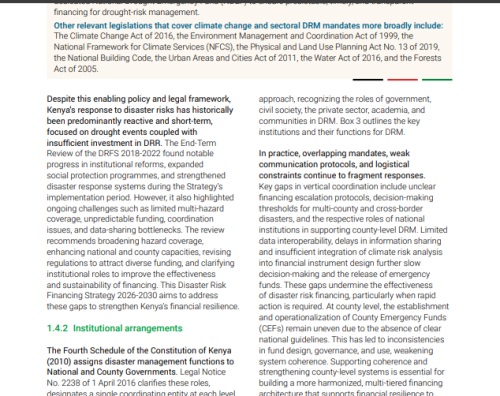
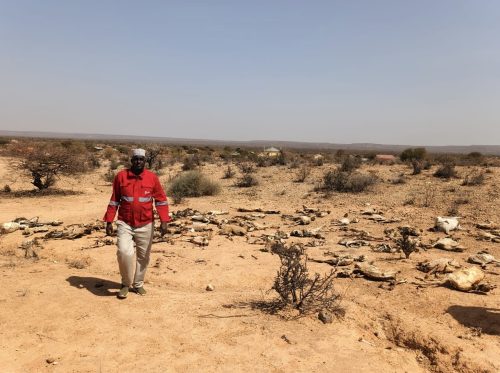
The findings come after Kenya endured successive climate shocks, including the devastating 2021-2023 drought that left 4.4 million people requiring humanitarian assistance and killed more than 2.1 million livestock, followed by the destructive 2023 and 2024 floods that caused an estimated Ksh187.82 billion in damage and economic losses.
These disasters tested county governments, which were the first institutions expected to rescue residents, establish temporary shelters, restore local infrastructure and coordinate relief operations. Yet the strategy concludes that counties remain financially constrained.
One of the biggest weaknesses is the uneven establishment of County Emergency Funds (CEFs). While the Public Finance Management Act allows counties to establish emergency funds of up to two per cent of their annual revenue, only 19 counties had operational County Emergency Funds by 2025, leaving more than half of Kenya’s 47 counties without dedicated emergency financing mechanisms.
Even among counties that have established emergency funds, the report identifies inconsistent governance and operational procedures.

“The establishment and operationalization of County Emergency Funds (CEFs) remain uneven due to the absence of clear national guidelines. This has led to inconsistencies in fund design, governance, and use, weakening system coherence,” the strategy states.
The report further points to broader coordination failures between the two levels of government.
“In practice, overlapping mandates, weak communication protocols, and logistical constraints continue to fragment responses,” it says. The strategy also cites “unclear financing escalation protocols,” delays in information sharing and weak integration of climate-risk data into financing decisions as factors that slow the release of emergency funds.
F/X
Although Kenya has developed several disaster financing instruments over the past decade, including the national Contingencies Fund, the National Drought Emergency Fund and County Emergency Funds, the strategy says financing remains fragmented and overly focused on responding after disasters occur rather than investing in preparedness and resilience.
Between 2017 and 2023, the national government spent approximately Ksh23.87 billion on emergency relief alone, about Ksh3 billion annually, excluding the much higher costs of reconstruction and long-term recovery. At the same time, high public debt and declining donor assistance are shrinking the fiscal space available for disaster management, making stronger county financing even more urgent.
To address these weaknesses, the strategy proposes harmonising County Emergency Funds through national guidelines, strengthening county disaster financing capacity, improving coordination between the National Treasury and county governments and expanding pre-arranged financing mechanisms that can release money rapidly when disasters strike.
Ultimately, the strategy argues that Kenya’s disaster financing system remains decentralised in responsibility but centralised in financing. Counties carry the constitutional obligation to protect communities during emergencies, yet their dependence on Treasury-controlled resources continues to delay action.
Unless county governments gain more predictable and accessible financing, the promise of devolution in disaster management will remain only partially fulfilled, leaving the country’s first responders waiting for funds while disasters continue to intensify.