Advertisement
Strong workforce vital for better healthcare
Monday 17th August, 2020 12:00 AM|
Many countries with better healthcare systems around the world have one underlying factor – a strong health workforce.
A healthy and strong workforce enhances reliability, drives better performance, and improves the outcomes of any healthcare system – resulting in vibrant growth of the economy as well as other sectors.
Over the years, the number of healthcare demands in our country has been on the rise, a factor that has been fuelled by the increase in population.
Data from the Kenya Health Workforce Report 2015 indicated an imbalance between healthcare professionals and patients – a factor which five years later, has continued to undermine the efforts to provide better healthcare services to all citizens.
You Might Also Like



In light of this, there is need to strengthen our health workforce through policy enactment, proper training, adequate planning, timely financing and most importantly, employment of more healthcare professionals.
This is imperative and it’s what global health organizations are advocating for.
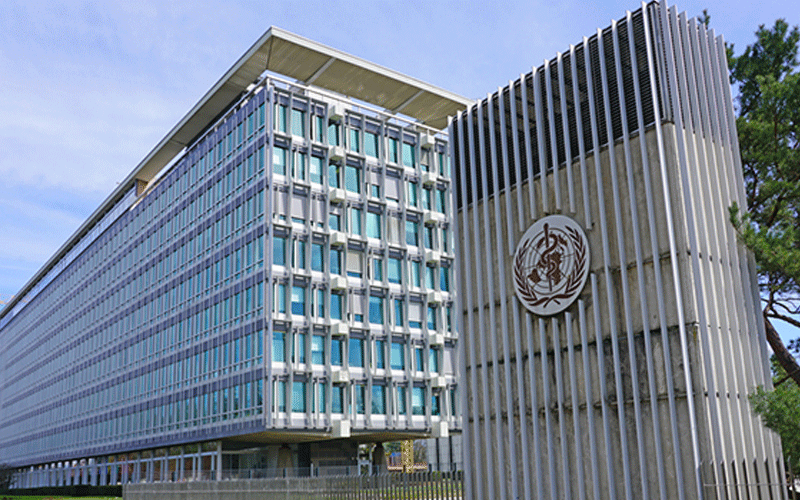
Last year, when the World Health Organisation (WHO) designated 2020 as the Year of the Nurse and the Midwife, no one knew of the looming health crisis ahead – the Coronavirus Virus Disease (Covid-19).
WHO did this in recognition of the great contribution by nurses and midwives in the healthcare system.
The health body went on to indicate that by 2030, the world will need nine million more nurses and midwives.
This hints that numbers in the health workforce play a crucial role in the development of health ecosystem.
As at 2020, Kenya has witnessed both infections and fatalities amongst her healthcare professionals from the Covid-19 pandemic.
As a result, there has been healthcare workers isolation, rotational working and increase in workload as cases continue to surge.
As this is happening, the National Nurses Association of Kenya (NNAK) and other healthcare bodies have been calling for employment of more healthcare professionals all along.
This is not a coincidence but a grave matter as far as better healthcare for all Kenyans is concerned.
Probably at one point you have envisioned what better healthcare service means, or even have gone to the extent of experiencing how it feels.
If that’s your case, you might be among the “chosen few” Kenyans since over the years, the dream of better healthcare still hangs in the air.
Majority of Kenyans cannot access safe, effective, timely, efficient, equitable and people-centred healthcare services which is vital for the country’s development.
Twelve years ago, the government launched the Vision 2030, which was envisioned as a vehicle for accelerating transformation of our country into a rapidly industrialised middle-income nation.
In this ambitious and yet noble initiative, which still is, the provision of equitable, affordable and quality healthcare to all citizens remains a top priority in the development blueprint.
As the adage goes, time waits for no man. Despite the slight improvement in the healthcare system in the last 12 years, much needs to be done in the next 10 years if we are to hit our target.
According to Kenya National Bureau of Statistics through the Economic Survey 2020, data indicated that the number of health facilities in the country increased by 5.2 per cent to 13,790 in 2019 with level 2 facilities accounting for 77.4 per cent of the total facilities. Levels 4, 5, and 6 hospitals collectively accounted for 5.8 per cent of the total facilities.
Covid-19 pandemic has exposed some of the weak points in our healthcare system – something which should open our eyes and challenge us to get better.
It is important for authorities to note that the various concerns being raised by associations and health professional bodies are meant for good.
There is need to increase the numbers of qualified healthcare professionals in order to improve our healthcare system.
This is essential to achieving the Universal Healthcare Coverage and other key pillars in our Vision 2030. —The writer is the President, National Nurses Association of Kenya
Author
Alfred Obengo
View all posts by Alfred ObengoLatest News






Advertisement
More on News