Senators grill Environment CS over pollution control failures
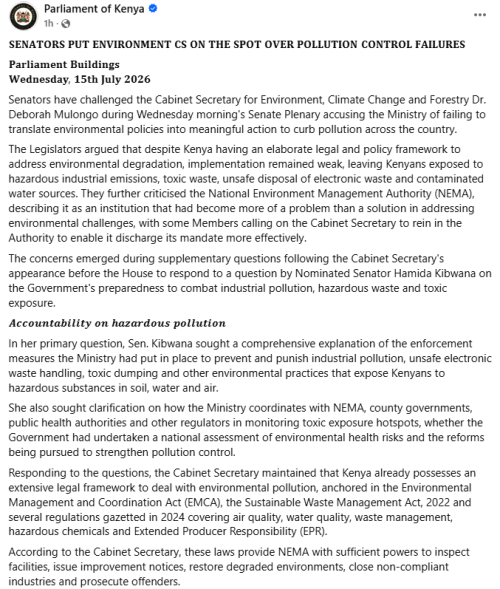
By Faith Lagat, July 15, 2026Senators have challenged Cabinet Secretary for Environment, Climate Change and Forestry Deborah Mulongo over what they described as weak enforcement of environmental laws, saying pollution continues to threaten public health despite an extensive legal framework.
The concerns emerged on Wednesday, July 15, 2026, during a Senate plenary as the Cabinet Secretary responded to questions about the government’s preparedness to tackle industrial pollution, hazardous waste, and toxic exposure.
Lawmakers said Kenya has sufficient laws to address environmental degradation but criticised the Ministry for failing to translate policy into meaningful action. They also raised concerns over the performance of the National Environment Management Authority (NEMA), saying stronger enforcement is needed to curb pollution.
The session followed a question by Nominated Senator Hamida Kibwana, who sought clarification on measures the Ministry has put in place to prevent industrial pollution, unsafe electronic waste handling, toxic dumping and other environmental practices that expose Kenyans to hazardous substances in soil, water and air.
Enforcement measures outlined
Responding to the Senate, Mulongo said Kenya’s environmental protection framework is anchored in the Environmental Management and Coordination Act (EMCA), the Sustainable Waste Management Act, 2022, and regulations introduced in 2024 covering air quality, water quality, waste management, hazardous chemicals and Extended Producer Responsibility (EPR).
She said the legal framework gives NEMA powers to inspect facilities, issue improvement notices, restore degraded environments, close non-compliant industries and prosecute offenders.
According to the cabinet secretary, NEMA carried out enforcement operations on 101 facilities in the Nairobi Metropolitan area during the last financial year to curb illegal discharge of industrial effluent into rivers and waterways.
She added that the Authority is identifying and shutting down 400 illegal discharge points along the Athi-Galana-Sabaki River system.
Mulongo told senators that environmental audits remain a key compliance tool, with 6,673 audits submitted during the 2024/25 financial year and nearly 9,800 reviewed in the current financial year.
She said the audits resulted in improvement notices and corrective directives being issued to facilities found to be violating environmental standards.
The cabinet secretary added that specialised compliance audits targeted hospitals, agrochemical companies, renewable energy projects, mining operations and asbestos disposal facilities.
She said two facilities had been closed for environmental violations, while five individuals were prosecuted over illegal discharge of industrial effluent during the previous financial year.
Focus on waste management
Mulongo said the government has strengthened implementation of the Extended Producer Responsibility framework, requiring producers to take responsibility for waste generated by their products after consumption.
She told the Senate that four Producer Responsibility Organisations are currently operational, managing hazardous waste, electronic waste and other waste streams.
According to the Ministry, 296 producers whose waste materials polluted rivers were required to undertake clean-up exercises and manage waste generated by their products.
She further disclosed that on July 10, 2026, NEMA facilitated an agreement under which hazardous waste pickers will receive Ksh20 per kilogramme of waste collected, while aggregators and transporters will also receive agreed payments to improve waste collection and safe disposal.
The cabinet secretary said Environmental and Social Impact Assessments involve consultation with regulatory agencies before projects are approved, while NEMA continues to conduct joint enforcement operations with agencies including the Energy and Petroleum Regulatory Authority (EPRA) and county governments.
She added that the Ministry has trained county officers through the Basic Enforcement Course before they are gazetted as environmental inspectors.
Senators demand implementation
Mulongo informed the House that a national assessment conducted under the Africa Environmental Health and Pollution Management Programme between 2020 and 2025 covered all 47 counties and identified widespread environmental health risks.
The assessment found that open burning of mixed waste and electronic waste remains a major source of toxic emissions, while informal electronic waste recycling exposes workers and nearby communities to dangerous substances, including lead and mercury.
She acknowledged gaps in laboratory capacity for analysing soil and air pollution but said the findings had informed new waste management regulations and pollution control measures.
Despite the Ministry’s response, senators maintained that the challenge lies in implementation rather than legislation.
They questioned why industrial pollution continues to affect rivers and communities despite regular inspections and environmental audits, arguing that enforcement agencies should prioritise action on the ground.
In her closing remarks, Mulongo assured the House that the government remains committed to strengthening enforcement, improving collaboration with regulatory agencies and enhancing pollution control measures to safeguard public health and the environment.