Senator Kibwana rebukes Murkomen over call to sack critical public officers
By Faith Lagat, August 12, 2025Mombasa Senator Hamida Kibwana has sharply criticised Interior Cabinet Secretary Kipchumba Murkomen’s directive that public servants who criticise the government should be dismissed immediately.
The exchange on her X post dated August 12, 2025, has ignited debate over whether loyalty to the administration should outweigh the constitutional rights of public officers.
Murkomen’s remarks
Speaking during a Jukwaa la Usalama town hall meeting in Narok on August 11, 2025, Murkomen declared, “Hakuna chief or assistant chief or police officers ambaye ataongea mambo against the government of the day, hakuna; it’s illegal; it’s unconstitutional. National government officers who speak ill of the government will be fired immediately.”
His statement came amid recent incidents of police officers openly voicing criticism, including popular Mugithi singer and police officer Samidoh, who has been associated with the anti-establishment slogan “Wantam”. Murkomen insisted his position applied to all administrations, past and future. “Hii government ikiondoka na ingine ikuje, lazima wewe, kama unlichose, to serve in public service, lazima urispect the government that will come,” he said.
He maintained that public servants may vote but must refrain from political campaigns or sloganeering, focusing on implementing government policy.
Kibwana defends right to dissent
Senator Kibwana responded by underscoring the value of constructive criticism in governance. “In public service, raising genuine concerns is essential to improving quality service delivery. Silencing such voices undermines accountability and weakens governance. Constructive engagement, not intimidation, builds a stronger nation,” she said.
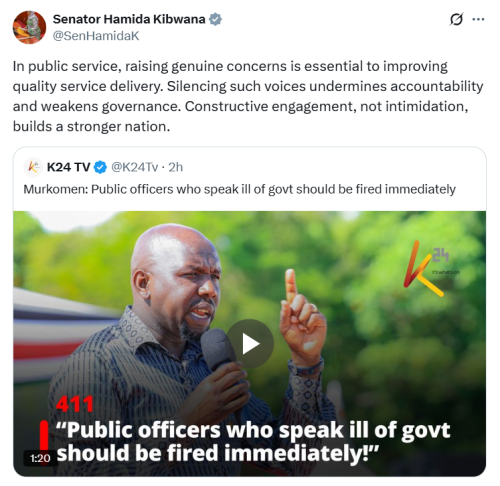
Her remarks align with the views of Senator Methu Muhia, who argued that the Constitution guarantees freedom of expression and association for all Kenyans, including public officers. Kibwana’s position reflects a broader belief that dissent strengthens, rather than weakens, public institutions.
Broader concerns
The clash has stirred wider concerns about shrinking democratic space in Kenya. Critics warn that Murkomen’s stance risks fostering a culture of fear among public officers and eroding their role as a check on executive power. The “Wantam” slogan, now symbolic of anti-government sentiment, has further fuelled tensions between state officials and dissenting voices within public service ranks.
Supporters of Murkomen argue that discipline and neutrality in the civil service are critical to effective governance, while opponents see his directive as an overreach that undermines constitutional freedoms.
As the debate intensifies, the issue has moved beyond a policy disagreement to a larger conversation about the health of Kenya’s democratic institutions and the delicate balance between government loyalty and the right to hold leaders accountable.