Advertisement
Scientists discover Africa’s oldest human burial
Friday 07th May, 2021 12:00 AM|
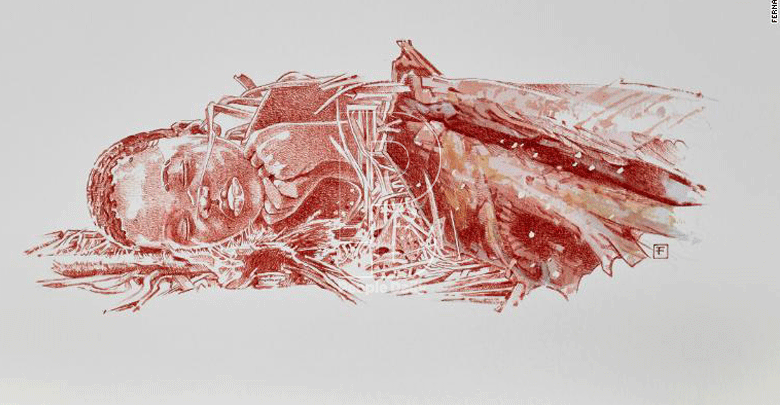
A toddler laid to rest with their head on a pillow in a cave in eastern Kenya is thought to be the oldest human burial ever found in Africa.
Remains of the child, who was between two-and-a-half and three years old, date back 78,000 years and were found buried at the mouth of the Panga ya Saidi cave, according to new research published Wednesday in the journal Nature.
An artist’s interpretation of the child, who was laid to rest in a cave in eastern Kenya 78,000 years ago. It is believed to be the oldest human burial ever found in Africa.
Analysis of the cave sediment and the bones suggested that the burial was intentional and perhaps involved the child’s wider community in funeral rites, the authors of the study said, demonstrating that humans at that time were capable of symbolic thought and complex social behavior.
The arrangement of the surviving bone fragments showed that the child was placed lying gently on their right side, with their legs folded and drawn up toward their chest.
Researchers also believe that the tiny body was tightly wrapped in a shroud — perhaps leaves or animal skins — and the head was supported by something made from a perishable material, possibly a pillow.
“This type of movement of the head is usually found in those burials where the head is resting over a pillow or perishable support — the moment that support disappears, disintegrates, decays, it creates a space below the head and because of gravity the head tilts,” said study author María Martinón-Torres, director at the National Research Center on Human Evolution in Burgos, Spain.
Some of child’s bones were first found during excavations at Panga ya Saidi in 2013, but it wasn’t until 2017 that the skeleton of the child, who was later nicknamed “Mtoto,” meaning “child” in Swahili, was fully exposed.
“At this point, we weren’t sure what we had found. The bones were just too delicate to study in the field,” said study co-author Emmanuel Ndiema of the National Museums of Kenya. “We had a find that we were pretty excited about — but it would be a while before we understood its importance.”—BBC
Author
Latest News







Advertisement
More on News