Advertisement
School gardens feed children with food and knowledge
Monday 01st November, 2021 12:00 AM|
When teachers at Kaloleni Primary School, a public primary school located in Nairobi introduced school lunch for all their pupils, their aim was to ensure that no pupil stayed hungry while in school.
But not all parents could afford to pay the required Sh70 per month for the meals. This resulted in absenteeism since students would be sent home every week to collect the said amount.
A similar situation was also observed at Star Shake Vision Academy, Mwiki, Nairobi, despite it being a private school.
Some parents who had pupils in that school couldn’t afford to raise the required amount.
Their children were either forced to carry lunch from home or stay hungry when others were taking their lunch.
However, things have changed in both schools since the introduction of The Nestlé for Healthier Kids Programme. Pupils are no longer sent home to collect money for their meals.
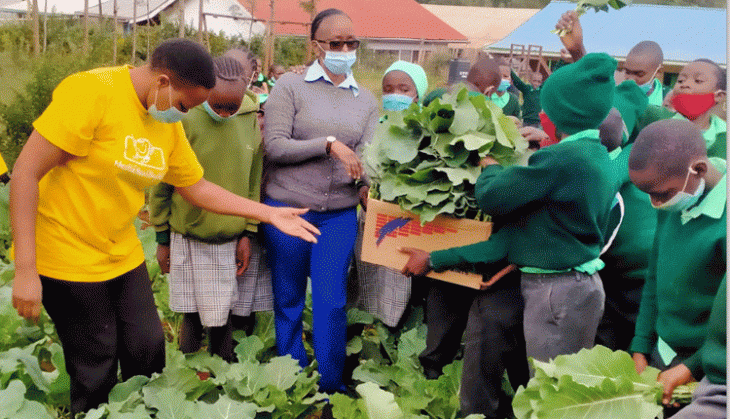
Now the schools have gardens that are providing food taken by the pupils for free.
According to Henry Oduor, deputy headteacher at Kaloleni Primary School, the school garden, which was set up with the help of Nestle Africa, has helped to promote proper nutrition, build lifelong skills, and increase knowledge about nutrition for students.
“At the garden, which is about 40 feet by 20 feet, we grow different types of vegetables as well as fruits.
The best part is that the produce grown in this garden supplements school feeding programmes and increases access to healthy food,” says Oduor.
On her part, Martha Macharia, Director at Star Shake Vision Academy says that apart from improving the food security among the students, the gardens have also had a positive impact on student performance since the level of absenteeism has been lowered.
Regular lessons
Another benefit is that students have also been replicating what they have been taught at home, something that is impacting their immediate families positively as well as the entire communities for years to come.
“With school gardens, students can see how food is grown in real life. At our school, children of different ages have regular lessons in the garden, learning how to grow, harvest, and prepare a variety of fruits and vegetables.
Healthy foods regularly incorporated in these children’s diets have been building good eating habits, thus teaching children to make good food choices,” says Macharia.
According to Trizah Waithaka, Nestle East Africa Regulatory and Scientific Affairs, Corporate Communication and Public Affairs Manager, the purpose of this programme is to raise nutrition awareness and promote healthy physical activity among children, who once they start practicing good habits are likely to continue with them throughout life.
“This programme seeks to enlighten parents and their children on the importance of healthy eating from the locally available foods.
We hope that this programme will be able to bridge the nutritional gap that is there for children,” says Trizah.
Under the programme, creative educational class materials for Grade One to Three are distributed in the primary schools, and teachers are trained on how to use the materials to integrate nutrition into the class lessons.
Beyond the classroom
The programme also involves training parents on nutrition education during Parent–Teacher Association (PTA) meetings to complement the knowledge transferred to pupils by teachers.
It also involves guiding and helping schools in setting up kitchen gardens to provide fruits and vegetables to supplement diets and also serve as training points for children on agriculture.
“School gardens are an amazing classroom tool with endless benefits for students that will extend beyond the classroom into their adult lives.
That is why we decided to start this programme. So far, we have reached more than 500,000 pupils in eight counties and about 700 schools are participating,” says Trizah.
All activities under this programme are guided by a technical committee, which comprises representatives from the Ministry of Education, City Education, and the Kenya Institute of Curriculum Development (KICD). Additionally, Nestlé works with a nutrition professor from Kenyatta University.
“The class materials have been developed in collaboration with the KICD, in line with the school syllabus.
The cost of development and production of the class materials is borne by Nestlé, which distributes the materials to schools free of charge as part of its support to the good health and well-being of the community,” revealed Trizah.
Author
Milliam.Murigi
View all posts by Milliam.MurigiLatest News







Advertisement
More on News