Ruto signs Division of Revenue bill 2026 into law
By Mustafa Juma, June 15, 2026President William Ruto, on Monday, June 15, 2026, officially assented to the Division of Revenue Bill, 2026, at State House, Nairobi, paving the way for the equitable sharing of national revenue between the national government and county governments for the 2026/27 financial year.
The signing ceremony was attended by Deputy President Kithure Kindiki, National Assembly Speaker Moses Wetang’ula, Senate Speaker Amerson Kingi, Attorney General Dorcas Oduor, senior parliamentary leadership, and a section of cabinet secretaries.
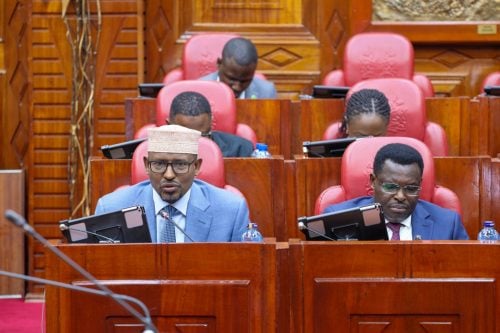
The law marks the conclusion of a prolonged dispute between the two Houses of Parliament over the amount to be allocated to counties.
Ksh428 billion allocation for counties agreed
The enacted framework sets the county equitable share at Ksh428 billion, following a compromise reached through a parliamentary mediation committee after weeks of deadlock between the National Assembly and the Senate.
The National Assembly had initially proposed a lower ceiling of Ksh420 billion, while the Senate pushed for an allocation exceeding Ksh450 billion, arguing that counties required increased funding to deliver devolved services effectively.
The mediation process ultimately produced what lawmakers described as a balanced agreement aimed at safeguarding both national fiscal stability and county service delivery.
Ksh2.9 trillion revenue sharing framework
The Division of Revenue framework is based on a total shareable revenue of Ksh2.901 trillion, which is divided vertically between the two levels of government.
The allocation is structured such that the National Government gets Ksh2.464 trillion, County Governments Ksh428 billion (equitable share), with Ksh10.25 billion going to the Equalisation Fund (for marginalised and underserved areas).
The Equalisation Fund is intended to support counties and regions that have historically lagged in access to basic services and infrastructure.
End to months-long parliamentary stalemate
The assent brings to a close a months-long standoff between the two Houses of Parliament that had delayed certainty over county financing.
The Senate had maintained that counties required higher funding to meet rising service delivery demands, while the National Assembly raised concerns over fiscal pressure on the national budget and debt obligations.
The mediation committee’s agreement is now expected to restore predictability in county operations and allow both levels of government to proceed with budget implementation for the new financial year.
Counties set for budget certainty
With the law now in place, county governments are expected to receive predictable funding flows that will support key sectors including healthcare, agriculture, roads, and early childhood development.
Governors have in recent months warned that delays or uncertainty in revenue sharing could disrupt service delivery and development planning at the devolved level.
The new framework is expected to stabilise intergovernmental fiscal relations ahead of the 2026/27 budget cycle.
Ksh502 billion allocated in 2026/27 budget
Treasury Cabinet Secretary John Mbadi announced that county governments are set to receive a total allocation of Ksh502 billion in the upcoming financial framework.
Speaking on the floor of Parliament, while reading the budget on June 11, 2026, Mbadi said the allocation comprises Ksh428 billion as the equitable share to counties, alongside Ksh74 billion categorised as traditional allocations drawn from the national government’s share of revenue, as well as loans and grants from development partners.
“Total allocation to county governments is projected at Ksh502 billion, of which Ksh428 billion is the equitable share and Ksh74 billion is traditional allocation from the national government’s share of revenue, loans, and grants from development partners,” Mbadi said.