Advertisement
Ruto reappoints Feisal Abass to head privatisation commission
Sunday 20th July, 2025 02:53 AM|

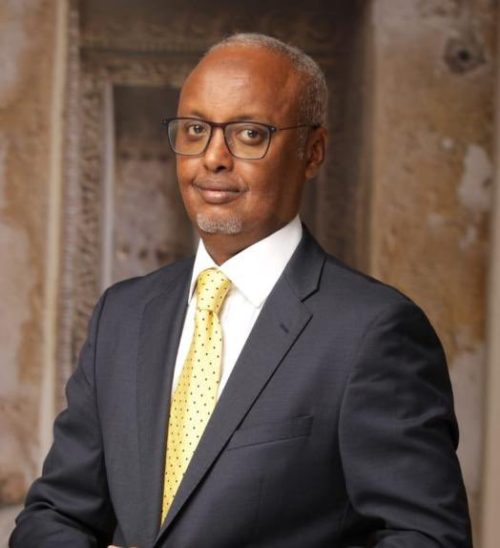
President William Ruto has reappointed Feisal Abass as the non-executive chairperson of the Privatisation Commission.
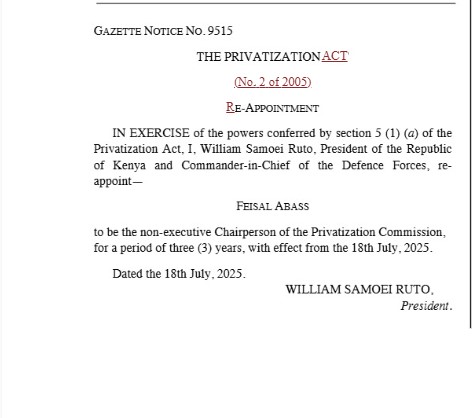
Through a gazette notice uploaded on the Kenya Law website on Saturday, July 19, 2025, Ruto confirmed Feisal Abass’s reappointment to that state agency.
The Privatisation Commission is a corporate body established under Section 3 of the Privatization Act (2005).
Its mandate includes formulating, managing, and implementing the privatisation programme, which has so far been touted by President Ruto’s administration.
You Might Also Like

The commission is also tasked with making and implementing specific proposals for privatisation in accordance with the privatisation programme.
Feisal Abass will be at the helm of the commission’s operations for the next three years.
“IN EXERCISE of the powers conferred by section 5(1)(a) of the Privatisation Act, I, William Samoei Ruto, President of the Republic of Kenya and Commander-in-Chief of the Defence Forces, reappoint Feisal Abass to be the non-executive Chairperson of the Privatisation Commission,” the notice read in part.
Privatisation agenda
In 2023, Ruto signed the Privatisation Bill, 2023 into law, repealing the Privatisation Act, 2005, which was enacted before the current Constitution.
The Bill removed the bureaucracy in the privatisation of non-strategic or loss-making government entities.
The Bill encourages more participation of the private sector in the economy by shifting the production and delivery of products and services from the public sector.
It improves the infrastructure and delivery of public services through the involvement of private capital and expertise.
Following the signing of the Bill, the Cabinet okayed the privatisation of various agencies and state corporations. However, the move to privatise KICC was largely opposed, leading to a court case.
In the September 2024 ruling, Justice Mwita stated that the KICC is a national monument and its proposed sale infringes on cultural and constitutional rights.
“The country is founded on principles of national governance, and the National Assembly must conduct its business in an open manner,” he said.
Author
Lutta Njomo
View all posts by Lutta NjomoLatest News





Advertisement
More on News