Russian troops survive 20 to 30 minutes on Ukraine front lines, CIA chief says
By Kenneth Mwenda, July 18, 2026Russian soldiers sent to the front lines in Ukraine may survive only between 20 and 30 minutes before being killed or wounded, according to CIA Director John Ratcliffe, who said modern drone warfare has changed the nature of combat.
Ratcliffe said US intelligence assessments show that low-cost, artificial intelligence-powered drones have become some of the most effective weapons on the battlefield, allowing Ukrainian forces to inflict heavy losses on Russian troops.
Speaking at the Pennsylvania Defense and Innovation Summit on July 15, 2026, the CIA director said the assessment matched reports emerging from open sources, including battlefield accounts from Russian military commentators.
“The average life expectancy of a Russian recruit right now, arriving on the battlefield in Ukraine, is estimated to be between 20 and 30 minutes,” Ratcliffe said.
He added that the short survival period was largely linked to the rapid expansion of AI-enabled drones, which have become specialised and inexpensive tools for targeting enemy positions.
“AI-powered drones have gotten to be such specialised, low-cost killing machines,” Ratcliffe said.
The comments provide one of the strongest public assessments from a senior US intelligence official on the impact of drone technology in the Russia-Ukraine war.
Drone warfare changes battlefield tactics
Since Russia launched its full-scale invasion of Ukraine in February 2022, both sides have increasingly relied on unmanned aerial systems for surveillance and attacks.
Ukraine has used drones to target Russian vehicles, supply routes, command posts and troops moving near the front lines. The technology has helped Kyiv slow Russian advances despite Moscow having a larger army and greater resources.
Ratcliffe said Ukraine’s use of emerging military technology has become a major factor in preventing Russia from achieving faster territorial gains.
“The mastery of these emerging technologies is every bit as important as military strength,” he said.
According to the CIA director, Ukraine’s ability to use drones and other asymmetric warfare methods has allowed a smaller military force to resist a much larger opponent for more than four years.
“That’s why an inferior force, four and a half years later, has held off the superior force of Russia,” Ratcliffe said.

The battlefield has increasingly moved away from traditional large-scale troop movements, with drones now playing a central role in identifying and striking targets.
Ukraine expands drone strikes beyond front lines
Ukraine’s growing reliance on drone warfare has also extended beyond the battlefield, with Kyiv using long-range unmanned systems to strike targets deep inside Russia.
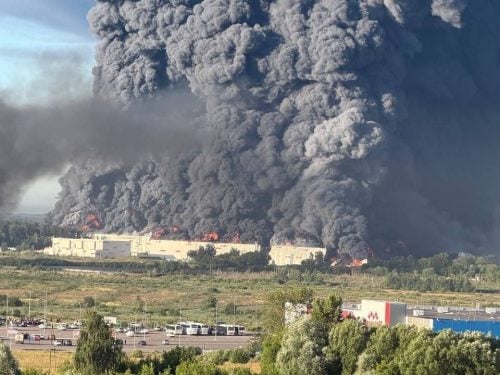
On July 18, 2026, Ukrainian drones hit two warehouses belonging to Wildberries, Russia’s largest online retailer, killing eight people and injuring 62, according to Russian officials. The strikes targeted facilities in Tambov and Elektrostal, including one located in the Moscow region.
Ukrainian President Volodymyr Zelensky said the attacks targeted major logistics facilities that were being used to supply components linked to drone production and navigation equipment. He said the strikes were carried out in response to Russian attacks on Ukrainian cities and civilian infrastructure.
The attacks showed the expanding role of drones in the war, with both sides using unmanned systems to target military assets, supply networks and critical infrastructure.
Ukraine has also intensified drone attacks against Russia’s energy sector. Kyiv says oil and gas facilities are legitimate targets because Russia uses energy revenues to support its military campaign.
Russia faces heavy battlefield losses
European and Ukrainian officials have repeatedly reported rising Russian casualties as Moscow continues offensive operations across parts of eastern Ukraine.
Ukraine’s military leadership has claimed Russia loses about 1,000 soldiers every day, although Moscow does not publicly release reliable figures on its battlefield losses.
Researchers at the Centre for Strategic and International Studies (CSIS) estimated that more than two million soldiers from both sides have been killed or wounded since the invasion began.
The researchers said Russia accounts for about 1.4 million casualties, including hundreds of thousands of deaths.
Their analysis found that the Russia-Ukraine casualty ratio increased sharply in the first half of 2026, reaching almost eight Russian casualties for every Ukrainian casualty.
The researchers linked the change partly to Ukraine’s expanded use of drones and precision strikes against Russian positions.
Russian recruits sent into dangerous assaults
Reports from Russian military bloggers have also described the severe conditions faced by newly deployed troops.
Some pro-war Russian commentators have claimed that recruits often spend weeks in training before being sent into direct assaults, where survival depends heavily on battlefield conditions.
Many Russian attacks have involved infantry units attempting to advance through heavily monitored areas where Ukrainian forces use drones to track movement and coordinate strikes.
The CIA assessment comes as concerns grow over the human cost of Russia’s continued military campaign.
Kenya has also been affected by the war, with the government recently revealing that hundreds of citizens were recruited into the Russian military.
Foreign Affairs Principal Secretary Roselyn Njogu said 289 Kenyans had been identified as having joined Russian forces. She said 64 had returned home, while 69 were either killed in action or reported missing.

The remaining 153 Kenyans are believed to be in military camps, on the front lines or their whereabouts remain unknown.
Njogu warned Kenyans against joining foreign armies, saying the risks of death and serious injuries in active conflicts were extremely high.
“Armed conflict necessarily means that people are dying. People are getting maimed. The likelihood of dying is very high,” she said.
US and Europe invest in drone technology
Ratcliffe’s remarks came as the United States and European countries increase support for Ukraine’s drone industry.
The European Union and Ukraine also deepened defence cooperation through a new defence industrial partnership and the EU-Ukraine Drone Deal, which aims to expand joint production of drones and counter-drone systems.
The European Commission announced a €1 billion (about Ksh148 billion) disbursement to support Ukraine’s drone capabilities under the €90 billion (about Ksh13.3 trillion) Ukraine Support Loan, including funding for drone procurement.
The growing investment reflects how drones have reshaped modern warfare.
For the United States, Ratcliffe said the lessons from Ukraine show the importance of maintaining leadership in advanced military technology.
He warned that countries that fail to develop emerging defence technologies risk falling behind in both security and economic competition.
The Russia-Ukraine war has demonstrated that expensive conventional weapons and large troop numbers are no longer the only measures of military power. Cheap, rapidly produced drones have become a decisive factor, changing how armies fight and survive on the battlefield.