RUPHA raises alarm over costly failures in SHA digital systems
By Kiprono Keileb, September 17, 2025The Rural Private Hospitals Association of Kenya (RUPHA) has sounded the alarm over what it describes as costly failures in the digital systems rolled out under the Social Health Authority (SHA).
In a statement posted on its official X account on Wednesday, September 17, 2025, RUPHA said the authority has failed to deliver on key health technology platforms that were meant to strengthen fraud detection, beneficiary management, quality control, and drug tracking.
“Let us break down the problems with the SHA failed fraud detection (SHA ERP), failed beneficiary management platform, non-existent Quality Management System and what the recently launched ‘Kenya Pharmaceutical Information System – Track & Trace,’” RUPHA said.
Also watch: MP Caleb Amisi pressures Duale to clarify SHA scandal
The association highlighted four major areas of concern, starting with the SHA eClaims system. According to RUPHA, “SHA eClaims System – rejects valid claims but can pay ghost hospitals. Apparently, SHA is currently procuring one after APEIRO failed to deliver a ghost-proof one.” The statement reads
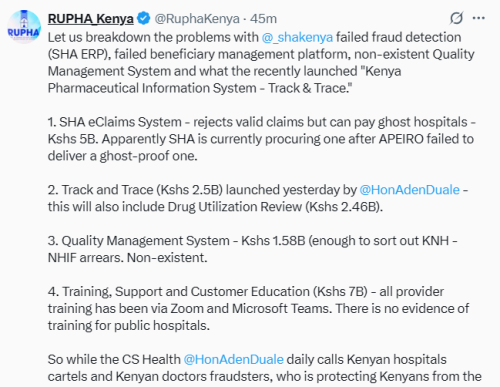
The statement further questioned the effectiveness of the newly launched Kenya Pharmaceutical Information System. “Track and Trace (Kshs 2.5billion) launched yesterday by Health CS Aden Duale – this will also include Drug Utilisation Review (Kshs 2.46billion),” RUPHA noted, suggesting that the investment might not deliver the promised accountability in pharmaceutical management.
On quality control, RUPHA stated that the system, supposed to safeguard service delivery, had not been put in place despite significant allocations. “Quality Management System – Kshs 1.58B (enough to sort out KNH – NHIF arrears. Non-existent,” the statement read.
The group also criticised how training and support for providers had been handled, questioning the effectiveness of virtual learning in strengthening public hospitals. “Training, Support and Customer Education (Kshs 7billion) – all provider training has been via Zoom and Microsoft Teams. There is no evidence of training for public hospitals,” RUPHA said.
The association challenged the Ministry of Health to address these gaps instead of focusing on accusations against medical professionals. “So while the CS Health Aden Duale daily calls Kenyan hospitals cartels and Kenyan doctors fraudsters, who is protecting Kenyans from the actual ones?” RUPHA posed.
The statement reflects growing unease among health stakeholders about the implementation of SHA reforms and raises questions about accountability in multi-billion-shilling investments.