Robert Mbui slams phone activation tax as KRA-Safaricom surveillance tool
By Kenneth Mwenda, June 22, 2026Kathiani Member of Parliament and Deputy Minority Leader Robert Mbui has strongly criticised a proposed phone activation tax in the Finance Bill 2026, describing it as unclear, impractical, and potentially linked to digital surveillance through telecom networks and the Kenya Revenue Authority (KRA).
Speaking during a morning interview on Monday, June 22, 2026, Mbui questioned how the tax would work in practice and warned that it could create confusion for both consumers and tax administrators.
“When I listen to the CS, he still continues to debate like the minority leader that he was when he was in the House,” Mbui said. He argued that the proposal lacked clarity and raised more questions than answers.
The proposed measure aimed to introduce a 25 per cent excise duty on mobile phones, collected at the point of activation on local networks such as Safaricom, Airtel, or Telkom. The government said the system would simplify tax collection and reduce evasion by linking taxation to actual use of devices in Kenya.
MP rejects idea
However, Mbui rejected the idea, arguing that the system was too complex and open to abuse. He said many mobile phones are sold in informal shops, especially in urban areas, and are often bought in sealed boxes without immediate activation.
“So at what point then will you be considered to have activated, and how will the tax man get his money?” he asked. He added that the ambiguity would make enforcement difficult and unfair to consumers.
Mbui also raised concerns about how the system would operate in practice. He suggested that the proposal could require close integration between mobile network operators and the tax authority.
“What it means is that there was going to be an attempt, probably to connect our phones and Safaricom with KRA,” he said. “That’s the only way that the tax would be able to follow up to get their tax.”
His remarks reflect wider concerns that the system could enable deeper monitoring of mobile devices and user activity, raising questions about data privacy and surveillance. Critics of the proposal have warned that linking activation data to taxation could give the state access to sensitive telecom information.
Mbui further questioned who would bear the cost of the tax—the buyer or the seller—and how the government would enforce compliance in a largely informal retail market.
“Is it you who buys the phone that pays for it, or is it the person who sells it to you?” he asked. He argued that the system lacked clear administrative rules and would be difficult to implement fairly.
He also challenged the government’s reasoning for shifting tax collection from importation to activation. Mbui said a simpler approach would be to apply any one-off tax at the point of importation rather than introducing a new digital system.
“If you wanted to put a one-off tax and you want to help Kenyans, why not just put it at the point of importation and it ends there?” he said.
Tax bill sparks policy debate
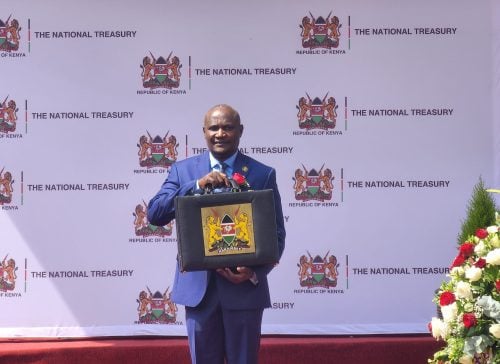
The Treasury, led by Cabinet Secretary John Mbadi, defended the proposal, arguing that it would improve efficiency and ensure that only phones used in Kenya attract tax. Officials also said it would help reduce smuggling and align taxation with actual consumption.
However, the proposal faced strong resistance from lawmakers during parliamentary discussions. Members of the National Assembly’s Finance Committee later reviewed the Finance Bill 2026 and recommended scrapping the 25 per cent excise duty on phone activation.
The committee, chaired by Kuria Kimani, said the proposal would create compliance challenges, delay revenue collection, and generate uncertainty for consumers and businesses. It ultimately recommended removing the clause entirely.
The committee also maintained zero-rated VAT status for key sectors, including electric motorcycles, electric buses, solar batteries, and materials used in animal feed production. Lawmakers argued that removing these incentives would raise production costs and discourage investment in local industries.
Despite dropping the phone activation tax, Parliament retained other tax measures in the Finance Bill 2026, including a tax amnesty programme set to begin in July 2026 and changes to tax filing deadlines.
Mbui’s criticism highlights broader tensions over Kenya’s tax policy, especially at a time when many citizens face high living costs. Lawmakers have increasingly questioned the balance between raising revenue and protecting consumers from complex or burdensome tax systems.