Right groups put police on notice over rising political violence, selective policing
By Faith Lagat, April 18, 2026Kenya is facing rising concerns over political violence and what civil society organisations describe as a growing culture of goonism, where hired groups are used to disrupt political events, intimidate opponents, and interfere with public gatherings.
The organisations link the trend to incidents during the 2024 Gen Z protests, noting that similar patterns have since extended into mainstream political activities ahead of the 2027 General Elections.
On Friday, April 17, 2026, a coalition of grassroots organisations issued a joint press statement addressing the National Police Service (NPS).
The groups included VOCAL Africa, Mukuru Social Justice Centre, Kituo Cha Haki Kibera, Dagoretti Women with Power, Utalii Mathare Community Organisation, and Dandora Grassroots Women Movement.
They stated that the incidents of violence have become organised and increasingly used as a political tool in various parts of the country.
The statement further noted that informal settlements remain key areas where young people are recruited into such activities, raising concern over their exposure to political manipulation and violence.
“The normalisation of violence as a political tool is not only irresponsible but is a direct invitation to chaos and anarchy as we edge closer to the 2027 General Elections. History has shown us that once violence is unleashed and institutionalised, it rarely remains controlled.”
Claims of selective enforcement
The organisations cited differences in police response to recent incidents as evidence of inconsistent enforcement of the law. They pointed to Kitale, where more than 170 suspects were arrested following disruption of the Niko Kadi/Tuko Kadi voter registration exercise, as an example of swift police action.
In contrast, they raised concerns over Kikuyu, where similar incidents linked to a political event involving former Deputy President Rigathi Gachagua were reported, including road blockades and confrontations. According to the statement, there has been no comparable police action in that case.
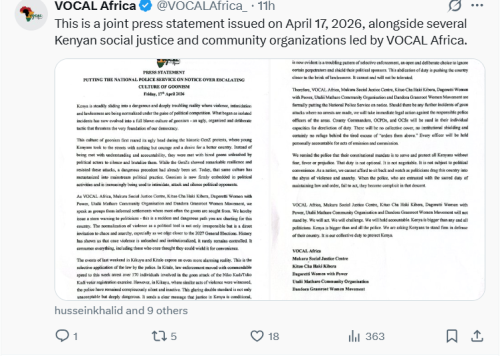
“The police have the capacity to act, as demonstrated in Kitale. What we are witnessing is a deliberate choice to shield certain perpetrators and their sponsors,” the statement read. The organisations said they would pursue legal action against County Commanders, OCPDs, and OCSs in their individual capacities if further incidents go unaddressed.
Police response and national security context
Inspector General Douglas Kanja, in a briefing shared on April 17, reported a 5 percent reduction in national crime rates in 2025 compared to 2024. He attributed the decline to intelligence-led policing, inter-agency coordination, and ongoing operations targeting terrorism, organised crime, and illicit activities.
Kanja also reaffirmed the National Police Service’s commitment to professionalism, human rights, and the rule of law, while cautioning against political violence and the use of criminal groups to disrupt public order.
Despite the reported reduction in overall crime, civil society groups maintain that politically linked violence remains a concern and requires consistent enforcement across all regions. The organisations called for equal application of the law and accountability in policing structures.
The coalition further urged citizens to remain vigilant as the country approaches the 2027 electoral period, stating that continued incidents of political violence could affect democratic processes if not addressed through impartial law enforcement.