Advertisement
Reprieve for State on Finance Bill after conservatory order
Wednesday 21st August, 2024 05:30 AM|
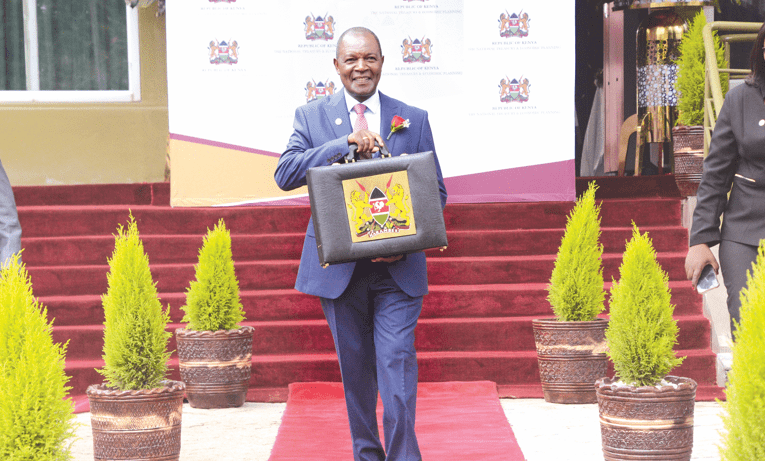
The government yesterday got a reprieve after the Supreme Court issued a conservatory order staying the lower court’s decision that declared the Finance Act 2023 unconstitutional.
The National Treasury Cabinet Secretary had moved to the apex court seeking to have the Court of Appeal’s ruling declaring the Finance Act 2023 unconstitutional set aside pending appeal.
In a ruling delivered on Tuesday, the judges found that public interest tilts in favour of granting conservatory and stay orders to preserve the substratum of the consolidated appeal and maintain stability in the budget and appropriation process pending the determination of this appeal.
“Based on the foregoing, we wish to disabuse the misconception that the element of public interest supersedes all the other elements when it comes to granting stay and conservatory orders,” the Supreme Court judges declared.
Revenue raising measures
The court took into account the uncertainty regarding the revenue raising measures and difficulty that may arise in the operations of the two levels of governments as posited by the applicants, coupled with the far-reaching implications of the declaration of the entire Finance Act, 2023 as unconstitutional.
In addition, in view of the public interest in the matter, the judges directed that the consolidated appeal be set down for hearing within the shortest time possible.
“A conservatory order is hereby issued suspending and staying the declarations in Orders iii, iv, vi, vii & ix(i) issued in the Court of Appeal judgment dated 31st July, 2024 in Civil Appeals Nos. E003, E016, E021, E049, E064 & E080 of 2024 (Consolidated) pending the hearing and determination of the consolidated appeal before this Court”, the apex court ruled.
The government had argued that the nullification of the Finance Act, 2023 will cause a revenue shortfall of approximately Sh214 billion which cannot be recovered unless stay orders are issued urgently.
The court was told that following the rejection/recession of the Finance Bill 2024, a similar bill cannot be re-introduced in the National Assembly until the expiry of six months from the date of such rejection/recession.
“The impugned judgment poses an immediate, real and immense challenge for the monetary and fiscal policy of the country, the legislative underpinnings of various sectors of the economy whose subsidiary legislation are set to lapse, and threatens the economic stability of the country,” they argued.
The Supreme Court decision will come as a huge relief to the government which was facing huge challenges in its bid to raise extra cash to fund the national budget and service its public debt.
Court of Appeal ruling
Kiharu MP Ndindi Nyoro, who chairs the parliamentary budget committee had lamented that the Court of Appeal ruling would cause significant shortfalls in this year’s budget and limit the government’s ability to run its affairs.
“If you look at both finance acts that have now fallen, cumulatively, we’re talking of over half a trillion shillings [$3.8bn] in lost revenue,” Nyoro warned.
The chaos of the government’s finances was illustrated when this year’s appropriations bill was signed into law as the corresponding finance bill to fund the spending plan was withdrawn.
With the government’s tax plans for two consecutive years effectively derailed, analysts say spending may have to be aligned with the finance legislation from 2022.
Economist Odhiambo Ramogi said the Court of Appeal decision created uncertainly for taxpayers, although the court ruled that taxes already collected cannot be refunded. The government on its part argued that it was not feasible to immediately reconfigure systems to the 2022 legislation, and the situation might lead to a paralysis of some government services.
Ramogi suggested that the best option for the government is to “redraft another finance bill”.
But given that Kenyans are strongly opposed to new taxes, the alternative would be to borrow more, he stated.
Credit rating body
Yet that too might be difficult, given the country’s debt levels and the recent downgrading of its rating by international credit rating agencies Moody’s and Fitch.
Others suggested that the solution could be to raise taxes that are innovative and not over-bearing for the public – though exactly how is not clear.
All the experts agree that for any future tax legislation, lawmakers will need to incorporate public opinion.
“Our national engagement and discourse on public affairs is shifting,” policy and governance expert Vincent Kimosop told the BBC, explaining that Kenyans are now actively participating in how their country is run.
Cutting down on spending will also need to continue.
Nyoro said the government had already made significant cuts and it still might be forced to do away with its entire development budget and salaries salaries for government workers.
“I would hate to imagine the education budget being cut, disruption in higher education funding, civil servants being laid off, healthcare coming a cropper,” he said.
Author
Print Reporter
View all posts by Print ReporterLatest News








Advertisement
More on News