Advertisement
Reforms at National Blood Transfusion Services paying off
Wednesday 15th June, 2022 01:19 AM|
The Ministry of Health believes that the ongoing reforms at the Kenya National Blood Transfusion Services (KNBTS), are finally paying off even as it announces a record collection totalling 297, 000 units of blood last year.
Health Chief Administrative Secretary, Dr. Mercy Mwangangi said previously, the blood collection ranged between 150, 000 and 170, 000, meaning last year’s collection doubled. In this year alone, as at the end of May, the agency mandated with the task of collecting, storing and distributing blood in the country has already collected 223, 000 units of blood.
This year, the Ministry is targeting 400,000 units of blood against a national demand of 500, 000, and says this is more than 50 percent of what was projected.
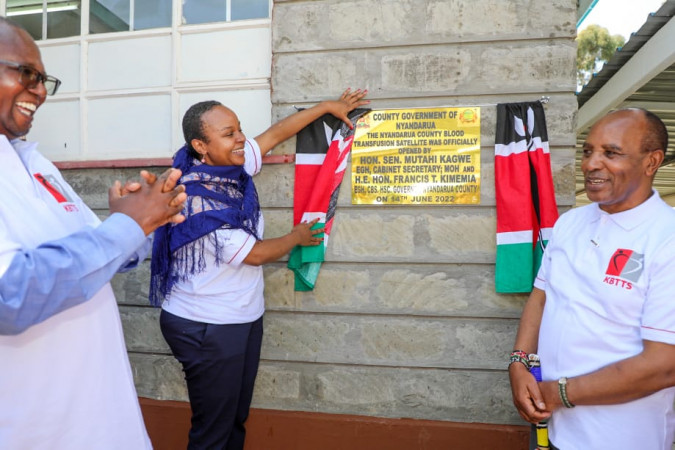
“We have doubled our blood storage in two years. Last year we transfused over 280, 000 Kenyans, a feat not achieved in the history of the country since independence,” Health Chief Administrative Secretary, Dr. Mercy Mwangangi said in Ol Kalou, Nyandarua county on Tuesday where she unveiled Nyandarua County Blood Transfusion Satellite Centre. It’s the country’s sixteenth blood processing facility.
“Things have changed at the country’s blood banks following the reforms we have been undertaking in the last three years,” Mwangangi said.
This optimism is also sustained by the increased blood storage capacity from 24,000 units two years ago to the current 50, 000 in the country’s blood banks.
Mwangangi noted that the blood situation in the country has improved, looking at how it was two years ago, and KNBTS, which is expected to have an expanded mandate, takes credit.
“So we are happy as a Ministry, we have done a tremendous job in our reforms in terms of leadership and governance; and the restructuring at KNBTS assisted by President Uhuru Kenyatta,” she added.
In view of this, it is reported that individually the President is happy with the performance of the blood agency, and he is expected to elevate it to a Semi-Autonomous Government Agency (SAGA). A few years ago KNBTS was experiencing a major governance and leadership turbulence, which saw it fail to manage blood pilferage, some said to be sold outside the country.
“In the next few days the President will make announcements on the ongoing restructuring at the Blood Transfusion services and the expected changes, how the agency will look like going forward so that we can have a platform where we efficiently collect and process blood and redistribute finished products to the rest of the country,” she said.
Its elevation to a SAGA will see KNBTS transform into an institution with an expanded role; beyond transfusion to include transplant services. It will become Kenya National Blood Transfusion and Transplant Services (KNBTTS) with a mandate including collection; testing, and distribution of blood and blood products in the country.
During a blood drive hosted by KNBTTS at the Strathmore University yesterday, Hungary Ambassador to Kenya Zsolt Mészáros, who donated blood for the fifth time, called on more people to volunteer and donate blood because it saves lives. “I am donating for the fifth time, and I am still feeling ok, I want to appeal to more Kenyans to volunteer and donate blood, for it saves a life,” Mészáros said.
While hosting the diplomats in the blood drive, KNBTTS Chief Executive Officer, Dr. Nduku Kilonzo revealed that the agency’s transformation has already seen it open sixteen blood satellites in the country, and likely to double in a few months to come.
“For instance, yesterday, during the World Blood Donor day we celebrated Nyandarua County as one of the 16 counties that are able to collect and process blood in the whole country,” she said, appealing to Kenyans to turn out in large numbers whenever there’s a blood drive to donate in order to save a life.
She said the aim is to have all the counties collect and process blood into various by-products by separating them from the main commodity into red cells; platelets, plasma, cryoprecipitated AHF (cryo), and granulocytes.
“In terms of counties that are able to collect we are at 36, we never used to be at this, but now 36 of them can collect blood and 16 can process it into various by-products and Nyandarua is one of them,” she added.
With the ongoing expansion of the agency, Nduku said each county government has a county blood transfusion officer (CBTO) who coordinates blood services at county level and works collaboratively with the Regional Blood Transfusion Centres (RBTCs), satellites and health facilities.
Nyandarua County has an annual demand of 7000 units of blood, and so far KNBTTS has installed three fridges each storing 75 units of blood, and in addition, there is a freezer for fresh frozen plasma.
“Nyandarua is able to raise 600 units per quarter with the storage capacity able to store 200 units per month,” Governor Francis Kimemia revealed.
The County has been relying 100 percent on sourcing blood for transfusion for its patients from Nakuru, Embu, Eldoret, Nairobi Regional Blood Banks since the inception of JM Kariuki Memorial County Referral back in 1975.
However, the need to self-sustain with adequate and screened blood pints for transfusion, Kimemia said the transfusion centre was founded due to the in-patient health facility expansion rate and the increase of health seeking behaviour of our population.
Kenya is estimated to have a population of 50 million people. According to the WHO, annual blood donation by 1 percent to 3 percent of a country’s population is sufficient to meet the blood needs. Kenya requires a minimum of 500,000 units of blood annually to meet the country needs.
KNBTTS has seen an upward trend in blood collection in the country from 172,000 to 297,000 blood units in 2021 and this year it is targeting 400,000 units of blood.
“This is due to adoption of innovative ideas and strategies such as the use of media to raise awareness and mobilize blood donors. KNBTTS has also adopted other strategies of acknowledging frequent blood donors, appointing blood ambassadors in the country, appointing youth-led groups for mobilizing youth population and engaging the county governments through the County Blood Transfusion Officers,” Nduku said.
To ensure adequate blood and blood components in the country, the Ministry of Health undertook significant reforms towards leadership and management of KNBTTS in the financial year 2020/21.
Author
George.Kebaso
View all posts by George.KebasoLatest News







Advertisement
More on News