Okiya Omtatah raises concern over unpaid staff in Busia
By Kenneth Mwenda, August 18, 2025Busia Senator Okiya Omtatah Okoiti has raised serious concerns over the delayed salaries of over 3,000 Busia County workers.
Taking to X on Monday, August 18, 2025, the Senator highlighted the negative impact the delays are having on essential services.
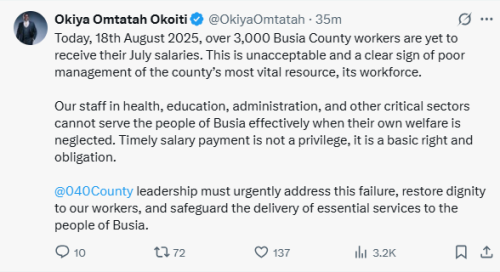
“Today, over 3,000 Busia County workers are yet to receive their July salaries. This is unacceptable and a clear sign of poor management of the county’s most vital resource, its workforce,” Omtatah said.
He stressed that staff in critical sectors such as health, education, and administration are struggling to serve the public effectively when their own welfare is neglected.
“Our staff in health, education, administration, and other critical sectors cannot serve the people of Busia effectively when their own welfare is neglected. Timely salary payment is not a privilege, it is a basic right and obligation,” he added.
Omtatah calls for urgent action
Omtatah urged the county leadership to act quickly to resolve the issue.
“County leadership must urgently address this failure, restore dignity to our workers, and safeguard the delivery of essential services to the people of Busia,” he insisted.
The delay affects a wide range of employees, including medical personnel, teachers, administrative officers, and other critical staff. Many end up facing financial challenges due to the lack of salaries, struggling to pay for basic needs and family obligations.
This is not the first time Busia County has faced salary delays. In August 2020, nurses in the county began a go-slow protest after their July salaries were not paid. At the time, the Kenya National Union of Nurses (KNUN) said that delays in salary payments were affecting staff morale and service delivery. Union officials met with county health department representatives to resolve the impasse, which followed previous strikes over promotions and unpaid Covid-19 allowances.
Busia County, home to roughly one million people, relies on both national government transfers and locally generated revenue to fund salaries and development projects. Delays in payments can have far-reaching consequences, including reduced morale among staff, interrupted public services, and growing public frustration.