NTSA clarifies vehicle inspection rules after public outcry
By Kenneth Mwenda, June 28, 2026NTSA has moved to calm growing public concern over the planned motor vehicle inspection rules after confusion and criticism spread across the country.
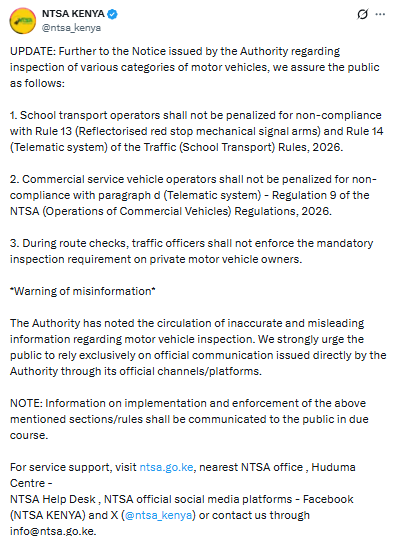
In a public notice issued on Sunday, June 28, 2026, the National Transport and Safety Authority (NTSA) clarified that some sections of the new regulations will not be enforced immediately. The authority also warned Kenyans against relying on false information circulating online about the inspection programme.
The statement comes days after strong reactions from motorists, transport operators and political leaders over the government’s planned annual inspection exercise for private and commercial vehicles.
According to the notice signed by NTSA Director General Nashon Kondiwa, school transport operators will not face penalties for failing to install reflectorised red stop mechanical signal arms and telematics systems under the Traffic (School Transport) Rules, 2026.
Commercial service vehicle operators will also not be penalised for lacking telematic systems required under Regulation 9 of the NTSA (Operations of Commercial Vehicles) Regulations, 2026.
At the same time, NTSA directed that traffic police officers should not enforce mandatory inspection requirements against private motor vehicle owners during normal road checks.
The authority said details on the full implementation and enforcement of the rules will be communicated later through official channels.
“During route checks, traffic officers shall not enforce the mandatory inspection requirement on private motor vehicle owners,” NTSA stated in the notice.
The clarification followed mounting public concern after reports emerged that all private vehicles older than four years would undergo compulsory annual inspection starting in July 2026.
Under the proposed system, motorists would pay Ksh1,000 booking fees and Ksh1,000 inspection fees for most vehicles. Motorcycles and three-wheelers would attract lower charges.
NTSA says the inspection programme aims to improve road safety by ensuring vehicles on Kenyan roads meet mechanical and safety standards. The checks are expected to cover brakes, tyres, lights, emissions and overall roadworthiness.
Leaders oppose NTSA plan
Kenya currently has more than six million registered vehicles. If fully implemented, the inspection programme could generate billions of shillings annually for the government.
However, critics argue that the policy may increase the financial burden on Kenyans already struggling with high fuel prices, insurance costs and the rising cost of living.
Among leaders who criticised the programme is former Interior Cabinet Secretary Fred Matiang’i. The Jubilee Deputy Party Leader called for the suspension of the inspection plan, describing it as flawed and poorly explained.
“Introducing another compulsory annual payment without demonstrating its necessity places yet another financial burden on households and businesses that are already under immense pressure,” Matiang’i said in a statement posted on X.
He questioned whether NTSA has enough capacity to inspect millions of vehicles without causing delays and congestion at inspection centres.
Matiang’i also demanded clarity on how much revenue the government expects to collect and whether there is evidence showing the inspections will significantly reduce road accidents.
“What safeguards have been put in place to ensure that this programme does not become another avenue for rent-seeking and harassment of motorists?” he asked.
Former Deputy President Rigathi Gachagua also opposed the plan and warned that it could trigger public resistance if implemented without proper consultation.
Despite the criticism, NTSA has maintained that annual vehicle inspection is already provided for in law. Director General Kondiwa recently said the authority is working to expand inspection capacity, including operationalising private inspection centres in future.
The authority has now urged Kenyans to rely only on official NTSA communication channels for accurate information.
NTSA warned that misleading claims circulating on social media have created unnecessary panic among motorists and transport operators.
For support and clarification, Kenyans have been advised to use the NTSA website, Huduma Centres, official social media pages and NTSA offices across the country.