November 27 by-elections to cost Kenyans Ksh700M, IEBC reveals
By Kenneth Mwenda, November 20, 2025Kenya’s Independent Electoral and Boundaries Commission (IEBC) says the upcoming November 27 by-elections will cost the country about Ksh700 million.
IEBC’s Chairperson of Election Operations Committee Ann Nderitu disclosed the figure during a television interview on Thursday, November 20, 2025, where she explained why Kenya’s elections remain among the most expensive in the world.
Nderitu said the Commission will conduct 22 by-elections next week, although the original number was higher. She clarified confusion around the count, noting that two ward races will not take place due to uncontested seats.
According to Nderitu, the estimated cost stands at Ksh788 million once all logistical needs are factored in. She said the largest expenses come from hiring and training electoral officials, and moving materials to all polling stations across the country.
“So that will cost around 788 million. Across all that, the greatest cost drivers actually are Electoral Officials,” she said.
“The payment of Electoral Officials, forms and the logistics of transport and all that. Logistics and Electoral Officials carries the heaviest of the burdens, including training of those Electoral Officials and then knowing how the materials will reach every polling station.”
These include far-flung areas such as Banisa and parts of Turkana, where the Commission will rely on air transport to deliver ballot papers and other sensitive materials.
“In some areas, we might have to use flights to take the ballot papers, especially in the far flung, like we have a member of National Assembly election in Banissa. We have another one, a county assembly ward in Trukana. So those far flung areas, it’s safer when you now take a flight and take the ballots.”
Nderitu also pointed to the heavy security features on Kenya’s ballot papers as another major cost driver. Unlike countries where ballots are printed at polling stations using normal printers, Kenya uses highly secured ballot papers with features that she says surpass those on banknotes.
“We have the ballot papers, we have seals, we have stamps, we have indelible inks, all those now combined is what now form the other.
“If you go to other jurisdictions, you are going to find people just, a ballot paper is printed in the polling station with a normal printer. In the polling station, when you are voting, then you just do something, then a ballot paper come out, some of them looking just like supermarket receipts, and then you tick it and then it becomes a ballot paper and it’s counted.”
“No security features. In Kenya, we have a ballot paper that have more security features than the money.”
She noted that this level of security is necessary because the Commission is not only managing elections but also managing public trust.
She compared Kenya’s situation to Sweden, where political parties themselves distribute ballot papers. She said such a system is possible only in countries with high trust in institutions, something Kenya is still working towards.
Ballot papers land
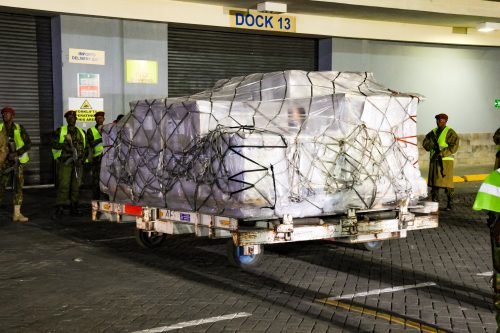
Earlier on Thursday morning, the IEBC received the first batch of ballot papers and statutory forms for the by-elections. IEBC Chairperson Erastus Ethekon confirmed that 10 pallets of materials arrived at Jomo Kenyatta International Airport, with another 29 pallets expected to land later in the evening.
The Commission will begin distributing all election materials to constituency tallying centres on Friday, 21 November.
Ethekon said the Commission has trained and deployed all personnel and is ready for the exercise. He emphasised that this by-election will be the first to be conducted under the new IEBC leadership and systems.
Ballot papers for the polls were printed in Athens, Greece, by Inform Lykos (Hellas) SA at a cost of Ksh27 million. Kenya continues to rely on foreign printing firms due to concerns about local trust levels, an issue Ethekon has previously raised.
The November 27 by-elections will fill several vacant seats, including the Baringo Senate seat, National Assembly seats, and numerous county assembly wards across more than ten counties. The IEBC has invited all 51 participating political parties to witness the arrival of ballot papers to ensure transparency.