Advertisement
NEMA orders counties to segregate waste at dumpsites
Friday 19th September, 2025 11:00 AM|

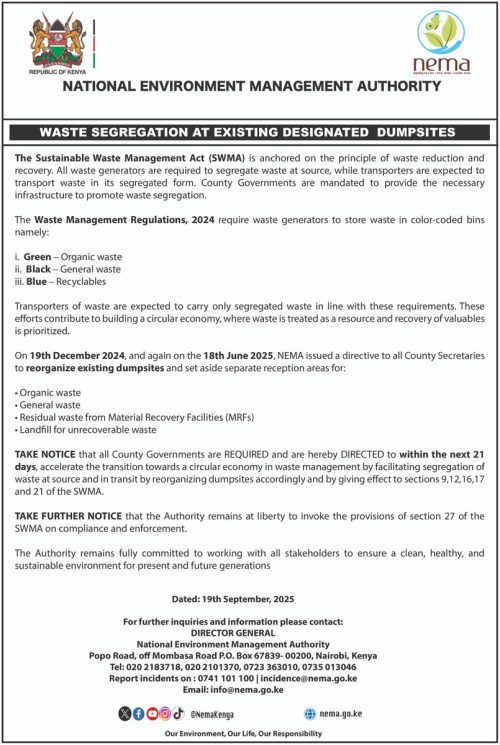
The National Environment Management Authority (NEMA) has directed all county governments to implement waste segregation at existing designated dumpsites, marking a key step toward a circular economy.
The directive, issued on September 19, 2025, requires counties to reorganise dumpsites within 21 days to accommodate organic waste, recyclable materials, material recovery facilities (MRFs), and landfills for unrecoverable waste.
“All waste generators are required to segregate waste at source, while transporters are expected to transport waste in its segregated form. County Governments are mandated to provide the necessary infrastructure to promote waste segregation,” read the statement.
“TAKE NOTICE that all County Governments are REQUIRED and hereby DIRECTED within the next 21 days to accelerate the transition towards a circular economy in waste management by facilitating segregation of waste at source and in transit by reorganising dumpsites accordingly.”
You Might Also Like



This move builds on earlier directives from December 19, 2024, and June 18, 2025, reinforcing the Sustainable Waste Management Act (SWMA) and the 2024 Waste Management Regulations. NEMA says the initiative is crucial for reducing waste, promoting resource recovery, and transforming waste into a valuable resource.
“The Waste Management Regulations, 2024 require waste generators to store waste in colour-coded bins, namely: i. Green – Organic waste ii. Black – General waste iii. Blue – Recyclables Transporters of waste are expected to carry only segregated waste in line with these requirements.”
Waste segregation at source and in transit
Under the regulations, households, businesses, and public institutions must segregate waste at the source using colour-coded bins: green for organic waste, black for general waste, and blue for recyclables.
Transporters are expected to carry only segregated waste, ensuring the process remains intact from generation to disposal.
“The segregation process is not only about compliance but about turning waste into a resource that can be recovered and reused,” NEMA stated.
Counties are tasked with providing the infrastructure necessary to support this system, a responsibility made more pressing by rapid urban growth and rising waste volumes.
Compliance and stakeholder cooperation
NEMA’s notice emphasises the urgency of compliance, referencing sections 9, 12, 16, 17, and 21 of the SWMA. The authority also retains the right to enforce the regulations under section 27 of the Act. In addition to directives, NEMA has provided contact points for counties and the public to report incidents or seek guidance.
The success of this initiative depends on effective county-level implementation, stakeholder collaboration, and public participation. NEMA has pledged to work closely with counties and other partners to ensure a clean, healthy, and sustainable environment for present and future generations.
Author
Latest News






Advertisement
More on News