NEMA breaks silence over Ritz-Carlton Masai Mara Camp amid public uproar
By Faith Lagat, November 29, 2025The National Environment Management Authority (NEMA) has officially confirmed that the Ritz-Carlton Masai Mara safari camp does not lie on or interfere with any wildlife migratory corridors in the Maasai Mara ecosystem.
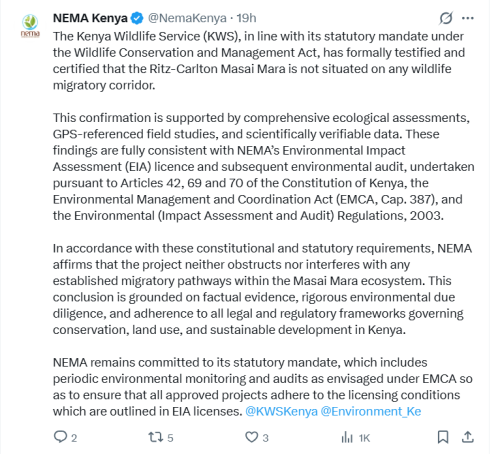
In a detailed statement issued on November 28, 2025, NEMA declared, “The Kenya Wildlife Service (KWS), in line with its statutory mandate under the Wildlife Conservation and Management Act, has formally testified and certified that the Ritz-Carlton Masai Mara is not situated on any wildlife migratory corridor,” read the NEMA X post.
The authority emphasised that this certification is backed by comprehensive ecological assessments, GPS-referenced field studies, and scientifically verifiable data.
NEMA further stated that these findings align fully with the Environmental Impact Assessment (EIA) licence issued for the project and subsequent environmental audits conducted under Articles 42, 69, and 70 of the Constitution of Kenya, the Environmental Management and Coordination Act (EMCA, Cap. 387), and the Environmental (Impact Assessment and Audit) Regulations, 2003.
“NEMA affirms that the project neither obstructs nor interferes with any established migratory pathways within the Masai Mara ecosystem,” the statement read, adding that the conclusion is grounded in factual evidence and strict adherence to legal and regulatory frameworks.
KWS clarifies migration concerns
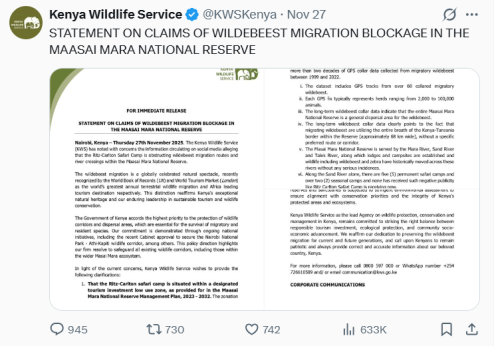
The confirmation follows a separate statement from the Kenya Wildlife Service issued on November 27, 2025, which addressed circulating claims that the luxury camp was blocking wildebeest migration routes.
KWS clarified that the Ritz-Carlton Safari Camp is located within a designated tourism investment low-use zone as outlined in the Maasai Mara National Reserve Management Plan 2023–2032, developed through joint scientific assessments by national and county governments.
Drawing on more than two decades of GPS collar data from over 60 migratory wildebeest tracked between 1999 and 2022, KWS explained that the entire Maasai Mara National Reserve functions as a general dispersal area for the herds, with animals utilising the full 68-kilometre breadth of the Kenya-Tanzania border without fixed corridors.
The data showed no evidence that the camp, situated along the Sand River alongside five other permanent camps and two seasonal ones, obstructs migration.
Ongoing monitoring
KWS also noted that many images and narratives circulating online are outdated, some dating back to 2018 and 2020, and may reflect competing commercial interests rather than current realities.
Both agencies reaffirmed their commitment to ongoing environmental monitoring, periodic audits, and balancing responsible tourism development with the protection of Kenya’s world-renowned wildebeest migration, recently recognised as the greatest annual terrestrial wildlife migration by the World Book of Records (UK).
NEMA stressed that all licensing conditions attached to the EIA will continue to be enforced to ensure sustained compliance and ecosystem integrity.