Advertisement
Namibia’s mandatory face mask order sparks entrepreneurship
Friday 15th May, 2020 12:00 AM|
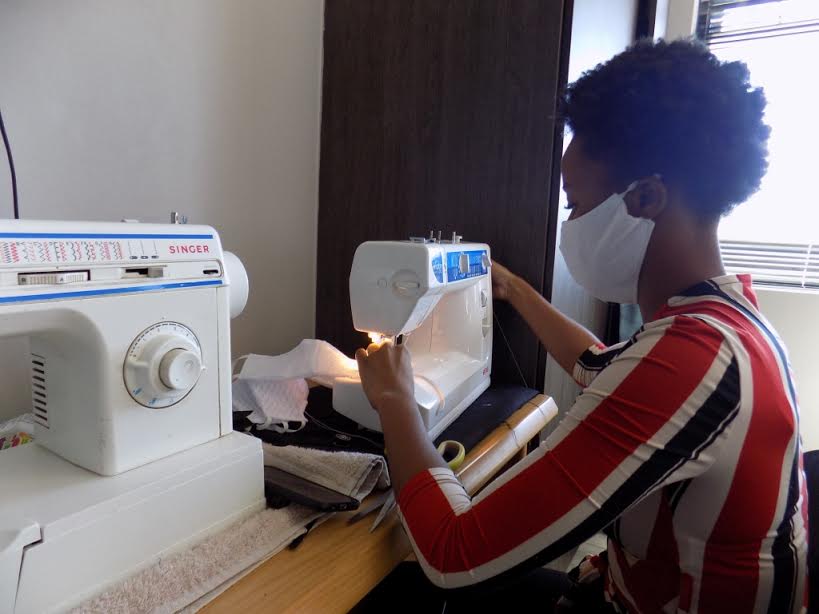
The mandatory wearing of face masks has ignited entrepreneurial spirit in Namibia. Many tailors are now making and selling reusable face masks to the public.
Namibia has made wearing face masks mandatory as the country entered stage two of the state of emergency regulations following lockdown from March 27 to May 4. The government on May 5 started to gradually lift the lockdown over four phases.
For Tiv Netumbo, a tailor based in the Namibian capital Windhoek, making masks has created an opportunity for her to generate an income amid a dwindling economy.
“People are not ordering clothing items anymore, so making masks is my new lifeline,” she said Wednesday.
According to Netumbo, she advertises her new mask commerce on social media, and only makes the masks based on orders. A single mask cost 15 Namibian dollars (about 0.8 U.S. dollar).
Henry Jongwe, whose enterprise customarily specialised in making uniforms, said that the business ventured into making masks to diversify products offering.
The enterprise, which produces an average 1,000 masks has since generated an income for the tailoring business in the Southern part of Namibia by supplying retail shops with masks in bulk and single units.
For Selma Shilongo, a tailor in northern Namibia also maximising on demand for masks, sees her efforts as a contribution to wider public health and the fight against COVID-19 pandemic.
“Masks are a protective gear, so I am honoured to be in a position where I am creating this product, and thus playing my part while I earn an income,” she said.
The masks are priced between 17 and 70 Namibian dollars, depending on size and design.
Meanwhile, the masks are also tailored for specific age groups. Ruberto Scholtz supplies masks for children, usually marketed on social media pages like Facebook.
The tailors added that the production of masks also goes a long way in providing more jobs to locals and subsequently reduce poverty.
The masks are made per the set of World Health Organization standards.
“Otherwise, you will not get customers. The public is aware of the specifications,” said Shilongo.
Mary Brantuo from the World Health Organization in Namibia said that the reusable masks could be made from different material and done in line with the set guidelines.
“These include consideration for criteria such as the type of material that is used, how breathable the material is, the number of layers needed in the material, repellent to water, size of the mask and how well it fits,” she said.
Meantime, according to the tailors, notwithstanding the congested market and completion, the sale of single masks is proving to be challenging.
“Some clients want to try on the masks before paying, which defeats prevention measures. More understanding by some of the local populace public is required,” said Netumbo.
But she is tenacious in her stance — clients are not allowed to try on the masks.
Meanwhile, health officials in Namibia have since embarked on educating the public on the use and handling of masks.
Augustine Kastheroday, a national infection control officer, said that public education efforts include hosting demonstrative sessions and information dissemination through the local media.
He further explained that the masks should have at least three layers to prevent further spread, and all individuals should wash their hands first before wearing the mask.
“Above all, it should be noted that masks are worn to protect others and not oneself. They are also not shareable,” Kastheroday said.
In the interim, since the use of face masks in public became mandatory in Namibia, shops and institutions are also denying members of the public without masks entry.
Namibia has recorded 16 cases of COVID-19, of which eight cases have recovered. (Xinhua)
Author
People Daily
View all posts by People DailyLatest News




Advertisement
More on News