Muturi dismisses Ruto’s compensation panel as a cover-up
By Faith Lagat, September 5, 2025Former Public Service Cabinet Secretary Justin Muturi has launched a scathing attack on President William Ruto’s newly constituted Panel of Experts on Compensation of Victims of Protests and Riots, describing it as a “political cover-up disguised as benevolence” and a “panel to nowhere.”
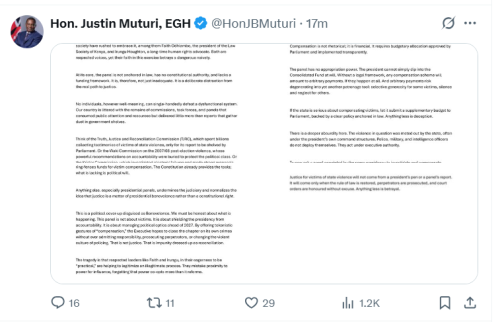
In a statement posted on X on September 5, 2025, Muturi said the panel, unveiled at the Kenyatta International Convention Centre (KICC) a day earlier, lacks legal authority, funding, and independence.
“The panel is not anchored in law, has no constitutional authority, and lacks a funding framework. It is, therefore, not just inadequate. It is a deliberate distraction from the real path to justice,” he argued.
The 18-member panel, chaired by Prof. Makau Mutua and deputised by Law Society of Kenya President Faith Odhiambo, was gazetted on August 25, 2025, with a 120-day mandate to design a compensation framework for victims of state violence. While Mutua hailed the move as “historic” and Odhiambo termed it “overdue,” Muturi dismissed both as dangerously naïve.
Failed commissions
Drawing from Kenya’s history, Muturi compared the panel to past commissions that failed to secure accountability, including the Truth, Justice and Reconciliation Commission (TJRC), the Waki Commission, and the Kriegler Commission.
“These commissions were created by law, staffed with experts, and backed by international support. Yet they still failed to deliver justice. How, then, can anyone expect a presidential panel without a legal foundation, budget, or independence to succeed?” he asked.
He stressed that justice lies within the judiciary, accusing the Executive of usurping powers by appointing a panel under its own authority. “Police, military, and intelligence officers do not deploy themselves. They act under executive authority,” he said, calling it absurd for the presidency to investigate its own alleged role in violence.
Public Skepticism and Call for Real Justice
Muturi’s criticism reflects wider skepticism. Amnesty International and the Kenya National Commission on Human Rights have documented dozens of protest-related deaths since 2017, including 63 during the 2024 Gen Z demonstrations and 38 in 2025 alone.
Families at the KICC launch demanded transparency, while lawyer Gitobu Imanyara dismissed the exercise as a “diversion from international scrutiny.” On social media, some Kenyans branded compensation efforts “blood money.”
Muturi also faulted civil society leaders like Odhiambo and human rights advocate Irungu Houghton for “laundering impunity under the guise of reconciliation.” Instead, he urged reforms that strengthen judicial independence and secure parliamentary funding for compensation. “Justice will come only when the rule of law is restored, perpetrators are prosecuted, and court orders are honoured,” he said.