Mulot boys nabbed in mobile banking fraud crackdown
By Kenneth Mwenda, December 7, 2025Detectives from the Directorate of Criminal Investigations (DCI) have arrested five individuals in Mulot over mobile banking fraud. The operation, carried out at the busy Mulot market, is part of a wider effort to curb digital fraud, which has become increasingly common across Kenya.
The five are currently in custody, undergoing processing before being arraigned in court. According to DCI’s statement, the five are likely to face charges including conspiracy to defraud, engaging in organised crime, and acquisition of proceeds from crime.
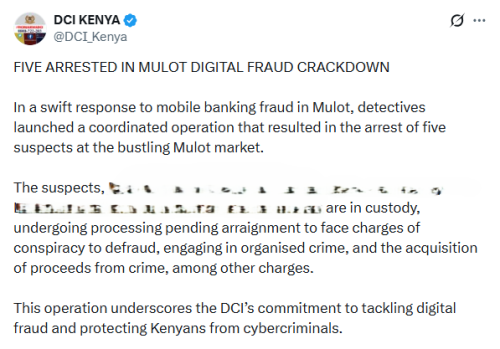
“In a swift response to mobile banking fraud in Mulot, detectives launched a coordinated operation that resulted in the arrest of five suspects at the bustling Mulot market,” the DCI statement read.
“The suspects, …, are in custody, undergoing processing pending arraignment to face charges of conspiracy to defraud, engaging in organised crime, and the acquisition of proceeds from crime, among other charges,” it added.
The crackdown highlights the growing threat of cybercrime in Kenya. A recent survey by TransUnion shows that four out of five Kenyans were targeted by digital fraud in late 2024, with 11 per cent falling victim.
The report noted that smishing, phishing, and vishing were the most common tactics, exploiting the country’s high mobile phone penetration, currently at around 133.7 per cent.
Mobile fraud threats surge
Mobile banking platforms have made financial transactions convenient, but they have also provided new avenues for criminals. Last year, losses from mobile banking fraud in Kenya rose sharply to Ksh810 million, representing a 344 per cent increase from 2023.
Users of mobile wallets such as M-Pesa and Airtel Money are particularly vulnerable, as scammers often pose as bank or service representatives to trick people into sending money.
Interior Cabinet Secretary Kipchumba Murkomen recently credited public awareness campaigns for reducing fraud in many communities, especially among women, who are often targeted due to their trusting nature. Murkomen noted that arrests of fraudsters, combined with education initiatives, have made it more difficult for criminals to operate.
Experts advise Kenyans to exercise caution when using digital financial services. They recommend ignoring unsolicited messages or calls requesting money or personal information, keeping detailed records of all transactions, and reporting suspicious activity to banks and authorities promptly.
Regularly updating passwords and monitoring accounts for unusual activity can also prevent fraud from escalating.
The Central Bank of Kenya (CBK) is also developing a compensation framework to help victims recover losses. Set to be fully implemented by 2026, the framework will include clear mechanisms for redress, improved complaint handling by financial institutions, and training to prevent fraud. The initiative forms part of the Kenya National Financial Inclusion Strategy 2025-2028.
Despite Kenyans being among Africa’s most digitally literate populations, cybercriminals continue to exploit trust within community platforms, gaming sites, online marketplaces, and social media.