MPs sound alarm over delayed IDs, poor funding and system gaps in Sotik registration offices
By Mustafa Juma, April 12, 2026Members of the National Assembly have raised concerns over persistent delays and resource shortages in the issuance of national identity documents in Sotik Sub-County.
The lawmakers have warned that the challenges are undermining access to essential government services.
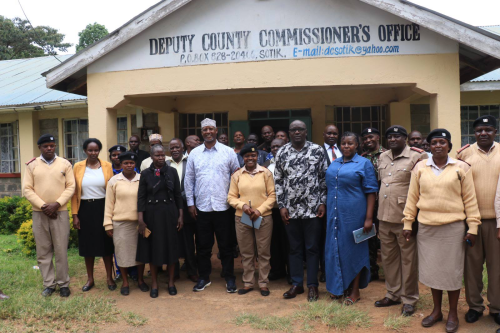
The concerns emerged on Saturday, April 11, 2026, during an oversight visit by the Departmental Committee on Administration and Internal Security led by Saku MP Dido Raso Ali, who toured the area to assess the performance of civil registration services, including birth certificates, death certificates, and national ID issuance.
The delegation included Suna West MP Peter Masara, Homa Bay Town MP Peter Kaluma, and Lari MP Mburu Kahangara, who engaged officials from the National Registration Bureau (NRB) and the Civil Registration Department.
Registration progress
Sotik Sub-County Principal Registrar Peris Kogei reported mixed progress, noting that policy changes, particularly the removal of vetting and application fees, had significantly boosted applications.
According to her, the office had achieved 4,059 new registrations against a target of 6,800, while 744 duplicate IDs had been processed out of a target of 1,200.
“The numbers have gone up because most residents here are farmers, and the removal of charges has encouraged more people to apply,” she said.
However, she cautioned that operational limitations continue to slow down service delivery.
Resource and infrastructure constraints
Kogei told MPs that the office is struggling with inadequate funding, poor infrastructure, and unreliable connectivity, all of which affect efficiency.
She revealed that in some instances, the office receives as little as Sh10,000 to run operations across multiple divisions, covering transport, logistics, and basic administrative costs.
“We need more materials and facilitation. Sometimes we are given very little to run operations, and that is not sufficient,” she said.
She further noted that the office processes between 70 and 150 applicants daily, but lacks adequate internet, equipment, and office space.
“Our office is small and currently housed within the correctional department. We also lack reliable internet, which limits our ability to track applications and assist clients in real time,” she added.
Thousands of IDs uncollected
The committee was also informed that more than 5,600 processed national identity cards remain uncollected, a situation partly attributed to population mobility in the region.
“Some applicants move away after applying and do not return to collect their IDs. However, local residents usually receive theirs through chiefs,” Kogei said.
She added that the average processing time for IDs is 21 working days, though delays occur in cases requiring additional verification.
Strict documentation rules
Lawmakers questioned the continued requirement for parental identification documents despite applicants already presenting birth certificates.
Kaluma challenged the policy, arguing that birth certificates should be sufficient proof of citizenship.
“If I already have a birth certificate issued through a credible government process, why should I still be required to produce my parents’ IDs?” he posed.
He called for a review of the registration framework to simplify the process, especially for elderly citizens and vulnerable groups.
However, the registrar defended the requirement, stating that additional documents help prevent identity errors, particularly in complex cases involving missing parental records or cross-community registrations.
“We do not deny anyone an ID, but we must follow procedures to avoid errors,” she said.
The committee also discussed the need to integrate civil registration services with the Independent Electoral and Boundaries Commission (IEBC) to streamline voter registration.
MPs proposed that citizens be automatically enrolled as voters once they obtain national IDs.
“We need systems that work together so that once someone gets an ID, they can be immediately registered as a voter,” Kaluma added.
Security and infrastructure gaps also featured prominently in the discussions, with legislators warning about vulnerabilities in digitised systems.
Raso cautioned that while digitisation improves efficiency, it also increases exposure to cyber risks if safeguards are not strengthened.
“It is a delicate balance. Data can easily be compromised if proper safeguards are not in place,” he said.
Officials also noted that lack of connectivity to central databases forces reliance on manual communication with headquarters, slowing verification processes.