Morara: Corruption killed factories and manufactured poverty in villages
By Mustafa Juma, December 31, 2025Businessman and political activist Morara Kebaso has blamed the collapse of agro-processing industries in Kenya on corruption.
Taking to his official X account on Wednesday, December 31, 2025, Morara blamed the vice for the deepening poverty in rural areas across the country.
He argued that Kenya’s economic struggles at the grassroots are not accidental but the direct result of the systematic destruction of local industries that once sustained farmers and rural economies.
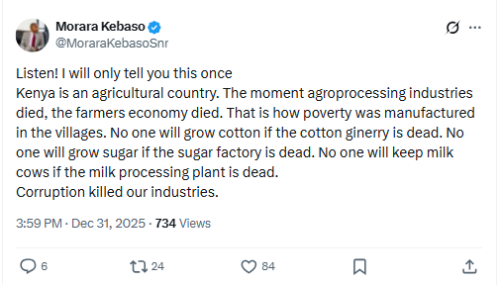
“Listen! I will only tell you this once. Kenya is an agricultural country. The moment agroprocessing industries died, the farmers’ economy died. That is how poverty was manufactured in the villages,” Morara stated.
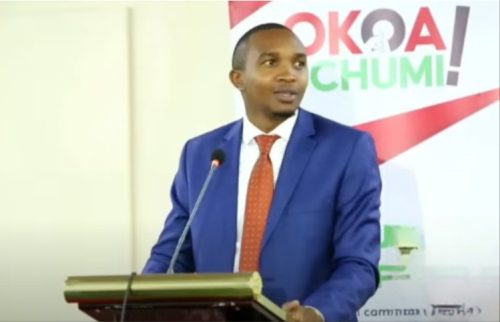
Death of industries
He explained that farmers respond to functioning markets, not goodwill or political slogans, noting that without operational factories, agricultural production becomes economically meaningless.
“No one will grow cotton if the cotton ginnery is dead. No one will grow sugar if the sugar factory is dead. No one will keep milk cows if the milk processing plant is dead.
Corruption killed our industries,” he wrote on X.
Corruption drivers
Morara had earlier claimed that Kenyan voters, rather than political leaders, are responsible for driving corruption and shaping the country’s political landscape.
He questioned the electorate’s role in electing leaders based on tribal loyalty and financial incentives, arguing that voters’ choices have deep implications for governance and development.
In a statement shared on X on Wednesday, December 31, 2025, Morara said the leaders do what those who elected them want, adding that electorates often enable leaders to misuse public resources without accountability.
“Politicians do what the boss (the voters) wants. If Gachagua weren’t tribal today, would he be popular? If Ruto hadn’t amassed billions through corruption, would he have won the presidency in a country where voters and their leaders want money? Let’s talk development,” Morara Kebaso said.
He further highlighted that a complacent electorate often enables leaders to misuse public resources without accountability. He added that electorates have donated their brains to be driven by those considered kingpins in the community.