Advertisement
Milestone surgery restores life for patient with kidney disease
Friday 09th February, 2024 05:50 AM|
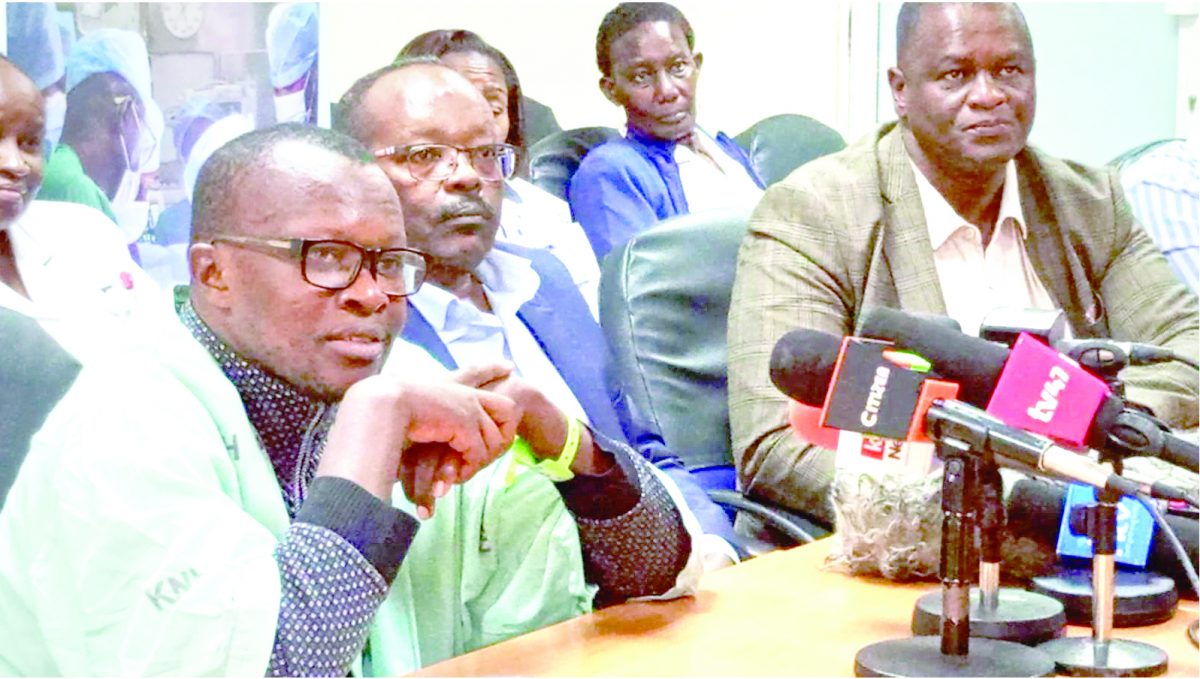
Dickson Njoroge, 36 sat calmly in a short-sleeved hospital gown, his chin resting on his fingers sewn together in a clenched fist, quietly giving testimony of his kidney failure and successful transplant.
“My kidney problems started on April 21, 2023. I came here at (Kenyatta National Hospital) and was diagnosed with Kidney failure. I had two options on the table: dialysis or transplant,” said Njoroge in a packed boardroom.
And once again, credit goes to the ever-innovating surgeons at the country’s largest public health facility.
The patient was admitted to the country’s main teaching and referral hospital last week to undergo a kidney procedure, months after experts recommended the same.
Njoroge opted for a transplant after months of dialysis, a treatment option which, he said, is not only expensive but also disruptive to his day-to-day activities. He realised that he was being drained of his finances, and easily chose a transplant when the options were tabled before him. “For three hours, two times a week, you feel dizzy, and sometimes it backfires, the catheter blocks, and sometimes you don’t even understand what’s going on. So, I decided to have a transplant,” he said.
He was accompanied by his cousin, Dickson Ndekei Wanjiru, the donor; “Right now I’m under medication.”
Njoroge was diagnosed with chronic kidney failure last year.
“I always felt tired and worn out after work, and could not sleep well so I thought these were normal signs and symptoms of diabetes. I have been a diabetic patient since 2004,” he said.
He added, “My eyes were yellowish, my sight was blurry which prompted me to visit Kikuyu Eye Clinic who indicated that most likely it was a renal problem; they referred me to KNH.”
Njoroge, calmly pointed out it was a sigh of relief as he finally knew his problem.
“Fortunately, the problem was diagnosed as kidney failure. I started dialysis sessions at the renal unit,” he added.
Njoroge, said that on learning that his brother and sister failed the ‘donor’ tests,
his cousin, Ndekei agreed to donate one of his kidneys. “I was then successfully transplanted my cousin’s kidney. I thank Ndekei, the management of the hospital and all the medical personnel who were involved in the process. May God bless you all,” said Njoroge.
On his part, Ndekei said he did not hesitate to help his cousin when he was informed of his predicament.
“This was a personal decision that did not need the family’s intervention. I’m happy I was able to help,’ he said.
Major milestone
Once again, yesterday’s three-hour procedure marked a major milestone for doctors at KNH after conducting the first-ever laparoscopic kidney transplant at a public hospital in Kenya.
The three-hour highly delicate minimally invasive surgery was conducted by a team of medics led by Dr Paul Njogu and Dr Charles Waihenya, both respected urologists in the country.
“We are moving from the traditional open method to a far more advanced modern frontier,” said Dr Njogu.
He added, “Thanks to technology, we are able to use computer guided laparoscopic instruments which make the process far safer to the donor and the recipient. The open one leaves a scar, but with this method it is barely noticeable and therefore aesthetically appealing.”
It takes less time thereby reducing the turnaround time, but with better clinical outcomes, he noted further.
While congratulating the team that conducted the procedure, the hospital’s Chief Executive Officer, Dr Evanson Kamuri, said KNH was working towards improving the operational efficiency of its kidney transplant program.
“We are also scaling up our ground-breaking surgeries in the facility,” he added.
Dr Kamuri said such a procedure, scientifically known as donor nephrectomy laparoscopic surgeries, was possible with the availability of the hospital’s tissue typing laboratory, the only one in the region.
“Our focus now is to increase the operational efficiency of our transplant program. This includes reducing our turnaround times. The presence of our tissue typing lab is also a bonus for us. It only takes a few days to get tissue typing results at a lower cost,” he said.
Traditionally, donor nephrectomy laparoscopic surgeries required a healthy individual, the donor, to undergo a major operation where the kidney was removed through an incision in the side using a large incision.
This so-called “open” procedure was associated with significant pain and a substantial recuperation period for the donor.
Author
George.Kebaso
View all posts by George.KebasoLatest News




Advertisement
More on News