Maraga reveals activist Davis Lichuma’s condition after hospital visit
By Mustafa Juma, June 29, 2026Former Chief Justice David Maraga has condemned what he described as the torture of activist Davis Lichuma after visiting him at Nairobi Women’s Hospital, where the social justice campaigner is receiving treatment days after he was reported missing following the June 25 commemorative protests.
In a statement shared via his official X account after the hospital visit on Monday, June 29, 2026, Maraga painted a grim picture of Lichuma’s condition, saying the activist was unable to speak and appeared deeply traumatised.
“I visited Davis Lichuma at Nairobi Women Hospital today. He’s not able to talk. You don’t need to be told what he’s gone through. His frequent tremors when asleep, most likely ‘post traumatic stress disorders’ (PTSDs), tells it all. Davis has been tortured,” Maraga stated.
“This is not acceptable and those behind it must be held accountable. We cannot be a nation that tortures, maims and kills its youth just because they seek good governance.”
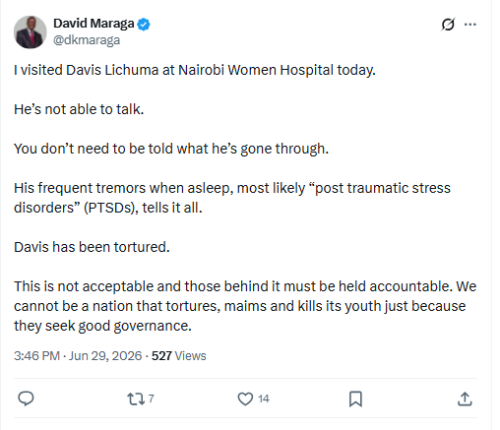
Maraga’s remarks came barely a day after human rights activists confirmed that Lichuma had been found alive after days of uncertainty over his whereabouts.
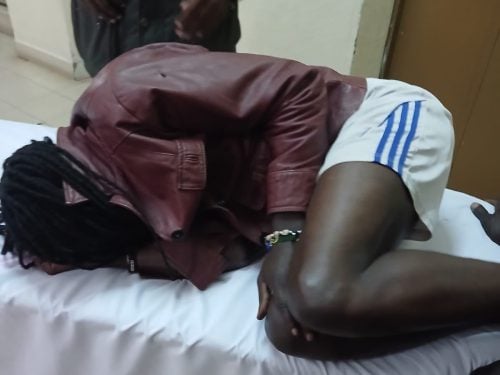
According to activists, he was initially discovered at Kenyatta National Hospital in critical condition before being transferred to Nairobi Women’s Hospital for specialised treatment. Rights groups said he was unable to speak when he was found and claimed that he bore signs of physical assault.
Disappeared after June 25 protests
Lichuma, a Mathare-based social justice activist, was reported missing after the June 25 demonstrations held to commemorate the second anniversary of the 2024 Gen Z protests.
Human rights organisations said he was among a group of activists arrested near Parliament during the protests before disappearing.
Family members and fellow activists launched an intensive search, demanding that security agencies account for his whereabouts. The National Police Service later confirmed that a missing person’s report had been filed at Nairobi’s Central Police Station and said investigations had commenced into the disappearance.
A day before Lichuma was found, Maraga joined relatives of missing activists and civil society groups in demanding that authorities either produce those reported missing or explain their whereabouts. Families warned they would organise nationwide protests if those missing were not accounted for.
Other protesters also found
Lichuma’s disappearance unfolded alongside growing concern over several other protesters who went missing following the June 25 demonstrations.
The Kenya Human Rights Commission (KHRC) and Amnesty International Kenya reported that six protesters who had allegedly been arrested during the demonstrations were later found abandoned in different parts of Nairobi after their families and rights groups raised alarm over their disappearance.
Those identified by rights groups included Collins Ochieng, Muteti Mulinge, Michael Ngigi, Elisha Alam, Fredrick Ojiro and Christine Walubengo. According to the organisations, the individuals alleged they had been beaten and tortured while in custody before being dumped and left to fend for themselves.
Rights groups have called for independent investigations by the Independent Policing Oversight Authority (IPOA) and the Kenya National Commission on Human Rights into the allegations, arguing that those responsible should be held accountable.
Renewed concerns over enforced disappearances
The latest developments have reignited debate over allegations of enforced disappearances and police brutality in Kenya, particularly during periods of political unrest.
The June 25 commemorative protests drew hundreds of demonstrators to Nairobi and other towns to honour victims of the 2024 anti-government demonstrations and demand justice for those who lost their lives. Interior Cabinet Secretary Kipchumba Murkomen said police arrested 355 people during the demonstrations over various alleged offences, while rights organisations criticised what they described as excessive use of force and arbitrary arrests.
As Lichuma continues receiving treatment, human rights organisations have maintained that establishing the circumstances surrounding his disappearance remains critical.