Maraga faults privatisation of public assets, warns of rising inequality
By Faith Lagat, February 6, 2026Former Chief Justice David Maraga has criticised the ongoing privatisation of public assets in Kenya, warning that the approach is concentrating wealth among a small group while deepening poverty and inequality, particularly in rural areas.
In a post on X dated February 6, 2026, Maraga took issue with the planned privatisation of the Kenya Pipeline Company (KPC), describing it as public property for private profit.
He argued that the sale of a 65 per cent stake in the company through an initial public offering (IPO) would largely benefit elites who can afford to buy shares, leaving ordinary citizens excluded from the gains.
“The ongoing privatisation of Kenya Pipeline concentrates wealth among the few who can afford to buy shares from the 65 per cent sale of a monopoly company that has been profitable,” Maraga wrote.
Privatisation and rural livelihoods
Maraga cited Tana River County as an example of how privatisation has affected communities at the local level. He said projects that could be managed by county governments for the benefit of residents have increasingly been handed over to private entities, with profits accruing to a small group of investors.
“The Galana Kulalu and Bura schemes, rice mills, gypsum mining, fisheries management, livestock export and milk production are just a few Tana River industries that have been privatised, in part or in whole, so that a few get super rich and the many continue to struggle,” he stated.
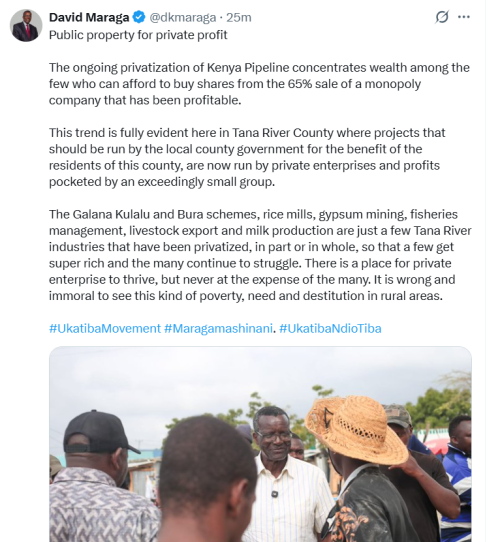
While acknowledging that private enterprise has a role in economic development, Maraga said it should not undermine the welfare of the majority. “It is wrong and immoral to see this kind of poverty, need and destitution in rural areas,” he added.
Parliamentary criticism and KPC IPO plan
Maraga’s remarks mirror earlier criticism from Mumias East Member of Parliament Peter Salasya, who in January 2025 questioned the rationale behind the proposed privatisation of KPC.
In a post on X on January 5, 2025, Salasya challenged the government’s decision to list the company on the stock exchange.
“Companies that are ordinarily taken to the stock exchange are either new, capital-starved enterprises, or firms whose profits are unpredictable and require public investment to stabilise and grow. KPC does not fall into either category,” Salasya wrote.
He described KPC as a mature national asset with extensive infrastructure, stable revenues and guaranteed markets, and questioned whether it had suddenly become financially unstable. Salasya called for transparency on what projects the company could not fund using its existing earnings.
The government plans to sell a 65 per cent stake in KPC through an IPO by March 31, 2026, following parliamentary approval in October 2025.