Advertisement
Local Covid firm ignored at home but feted globally
Wednesday 22nd December, 2021 06:30 AM|
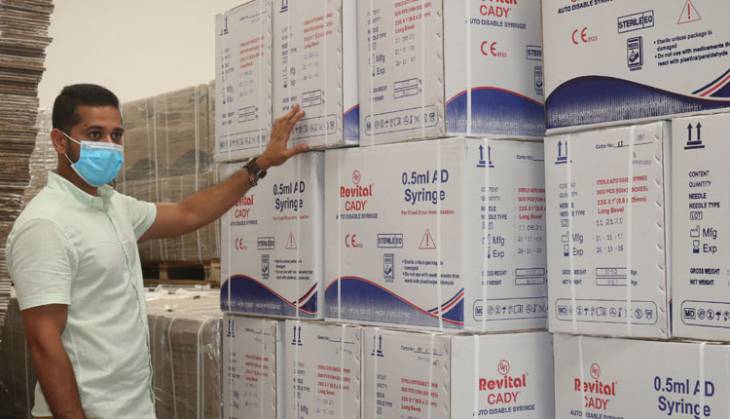
Kilifi-based Revital Healthcare (EPZ) limited, a manufacturing company that produces Covid-19 equipment is the epitome of the biblical maxim that a prophet is never honoured at home.
Nonetheless, the company has underscored Kenya’s manufacturing capacity by becoming one of Africa’s largest exporters of Covid-19 vaccine syringes.
But the firms local fortunes have, however, exposed the irony of the government’s failure to walk the talk on the “Buy Kenya Build Kenya” strategy, whose objective is to promote consumption of local products and services.
Nestled in the balmy Kikambala area, some 30km North East of Mombasa, the state-of-the-art healthcare devices manufacturer produces more than 45 medical devices which are exported to over 21 countries.
Despite the growing local demand for medical devices, the company exports 70 per cent of its products, with only 30 per cent sold locally.
Early this month, Revital became the first African company to export vaccine syringes to India when it flagged off its first consignment of three million pieces of 0.2ml vaccine syringes to the Asian nation.
RoneekVora, the Sales and Market Product Development Director at the company, says it will from next month start manufacturing bubble continuous positive airway pressure (bCPAP) system, a portable non-electric, life-saving device for newborns.
“A Havard University professor identified Revital to manufacture these devices because when Covid-19 struck, a lot of ventilators were taken from neonates to Covid patients and this means the infants, in their first 28 days after birth, were left without ventilators.
This professor then came with bcPAP. He could have gone to India or China but he believed in us. Come January we are going to launch this product,” said Vora.
Dead space
According to Revital Technical Director Krupali Shah, the device is capable of providing blended and purified oxygen to newborns without the use of electricity.
“It relies on pressurised oxygen gas from the cylinder to run,” explains Shah.
The World Health Organisation, Unicef, Covax, PATH and Bill and Melinda Gates Foundation have predicted a shortage of 2.2 billion auto disable syringes as early as next year.
This is because the world was not prepared for mass vaccination campaign of the current magnitude.
It is for this reason that countries are in a rush for the next alternative vaccine syringe, the 0.2ml auto-disable syringe which has a low dead space (the volume of medical product remaining in the needle and the hub of a syringe after an injection).
In October, the Ministry of Health said a delay in the administration of the one million Pfizer vaccine doses donated by the US government had been caused by lack of specialised dead space syringes.
At the time, Vora says, the company was ready to donate close to four million syringes that are still at the company’s storage.
“We are ready to help the government because we are here to complement each other. I believe in the local content policy of buy Kenya, build Kenya. Unfortunately, with the 45 range of products that we produce including PPE kits, surgical masks, different types of rapid diagnostic testing kits, syringes etc, the government of Kenya only procures three to four products. But if you look at Tanzania and Uganda, they buy more than 10 medical devices from us. I hope that our government follows the President’s policy of Buy Kenya, Build Kenya,” says Vora.
He says Kenya and Africa have the capacity to manufacture vaccines and other high quality medical products.
Vora says the governments of Uganda and Tanzania have shown interest by opening their doors for the company to set up industries.
Tanzania, he revealed, had promised to support the firm by imposing import duties on products from Asia and Europe.
Author
Reuben.Mwambingu
View all posts by Reuben.MwambinguLatest News








Advertisement
More on News