Ledama demands tax cuts to revive local industries and curb imports
By Kenneth Mwenda, January 18, 2026Narok Senator Ledama Olekina has sparked a debate after calling on the government to cut taxes on local manufacturing and restrict imports to revive struggling industries.
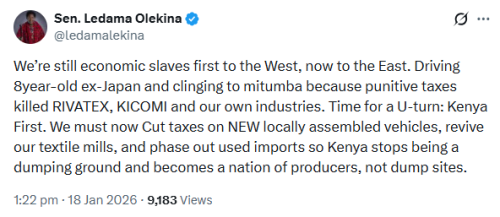
In a post shared on X on Saturday, January 18, 2026, the Narok County senator urged Kenya to prioritise domestic production. He called for lower taxes on new locally assembled vehicles, the revival of textile mills, and a gradual ban on used imports. Ledama said these measures would help Kenya move from being a dumping ground to a producer economy.
He criticised Kenya’s reliance on used cars from Japan and second-hand clothes, known locally as mitumba. He blamed high taxes and poor policy choices for the collapse of key industries such as RIVATEX and KICOMI. He said Kenya must make a U-turn and put its economy first.
“We’re still economic slaves first to the West, now to the East. Driving 8year-old ex‑Japan and clinging to mitumba because punitive taxes killed RIVATEX, KICOMI and our own industries,” Ledama wrote.
“Time for a U‑turn: Kenya First. We must now Cut taxes on NEW locally assembled vehicles, revive our textile mills, and phase out used imports so Kenya stops being a dumping ground and becomes a nation of producers, not dump sites.”
Imports versus local industry
Mitumba remains a sensitive issue. The trade employs about two million Kenyans and generates around 100 million dollars each year. Critics argue that second-hand clothes undermine local textile production.
However, several studies show the trade often serves low-income consumers and complements, rather than replaces, locally made clothing. Clothing accounts for about 2.5 per cent of private spending in Kenya, valued at nearly 200 billion shillings.
The vehicle market presents similar tensions. Kenya imports about 7,600 used cars every month, mostly from Japan. These vehicles attract heavy taxes, including import duty, excise duty, and VAT. In recent years, the government has raised age limits and taxes to support local assembly. New rules introduced in 2025 increased the price of small cars by up to 800,000 shillings.
Local assemblers such as Isuzu have benefited from incentives and increased production. The National Automotive Policy, rolled out in late 2025, aims to boost assembly and reduce reliance on imports.