Koskei hails Kaptagat conservation model as blueprint for sustainable livelihoods
By Emmanuel Rono, July 11, 2026Chief of Staff and Head of the Public Service Felix Koskei has hailed the Kaptagat Integrated Conservation Programme (KICP) as a model for how forest conservation and community prosperity can advance together through an integrated approach that combines ecosystem restoration with sustainable livelihoods.
Speaking during a mass tree-growing exercise at the Sabor and Penon forest blocks in Keiyo South Constituency, Elgeyo Marakwet County, Koskei said the programme has evolved beyond traditional tree planting by integrating forest restoration with water catchment protection, climate action and income-generating opportunities for communities living around the ecosystem.
“Kaptagat has shown that conservation works best when communities become beneficiaries and partners in protecting the environment,” Koskei said.
He noted that the programme has become one of Kenya’s leading examples of community-led conservation by linking environmental restoration with household wellbeing, water security and economic empowerment.
The tree-growing exercise formed part of the 10th Edition of the Kaptagat Integrated Conservation Programme, which ran from July 4 to July 11 in support of the government’s ambitious target of growing 15 billion trees by 2032.
The week-long initiative targeted the planting of more than 800,000 tree seedlings across the Sabor and Penon forest blocks while advancing broader ecosystem restoration efforts aimed at strengthening biodiversity and climate resilience.
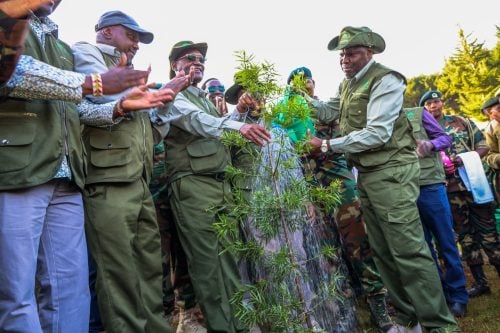
Koskei emphasised that protecting forests and water catchments remains critical as Kenya grapples with the growing effects of climate change and mounting pressure on natural resources.
He added that healthy ecosystems are essential for sustaining agriculture, securing water supplies and supporting livelihoods for future generations.
KFS backs integrated conservation approach
The Kenya Forest Service (KFS) echoed Koskei’s sentiments, describing the Kaptagat Integrated Conservation Programme as a flagship model demonstrating how environmental restoration can go hand in hand with economic and social development.
In a statement issued on Saturday, July 11, KFS said Chief Conservator of Forests Alex Lemarkoko joined Koskei, national and county leaders, and other stakeholders in a series of development engagements under the programme as part of the government’s integrated approach to ecosystem restoration and sustainable rural development.
The activities included the launch of Cheminye Dam, a tour of a climate-smart demonstration farm, the commissioning of the Kapkoi Cow Hotel and a consultative engagement with professionals and farmers at Kimore Boys Hall.
According to KFS, the forum focused on sustainable land management, climate-smart agriculture, environmental stewardship and the critical role communities play in protecting natural resources.
The agency said investments in water infrastructure, climate-smart farming, modern livestock management and community capacity building directly complement forest conservation efforts by addressing some of the underlying drivers of forest degradation.
“Investments in water infrastructure, climate-smart farming, modern livestock management, and community capacity building help reduce pressure on forests while improving food security, strengthening livelihoods, and enhancing resilience to climate change,” KFS said.
The agency added that promoting integrated landscape management through partnerships linking forest conservation with water security, agricultural productivity and socio-economic development remains central to the sustainable management of Kenya’s natural resources.
“The Kaptagat Integrated Conservation Programme remains a flagship model for balancing environmental restoration with community prosperity, demonstrating that healthy forests are central to resilient communities and sustainable national development,” KFS stated.
Kaptagat Forest fully restored
Meanwhile, National Treasury Principal Secretary and Patron of KICP Dr Chris Kiptoo announced that the programme had reached a major milestone with the complete restoration of the Kaptagat Forest ecosystem after the final degraded section at Chebior in Sabor Forest Station was replanted.
“The Kaptagat Forest Ecosystem comprises the Kipkabus, Penon, Kaptagat, Sabor, Kessup and Elgeyo Forest Stations. I am pleased that the ecosystem has now been fully restored, with the final section, a 22-hectare grassland at Chebior in Sabor Forest Station, planted today,” Kiptoo said.
He revealed that the next phase of the programme will focus on rehabilitating the Keiyo Escarpment and hanging valleys while promoting tree growing on community and private farms through the distribution of avocado, coffee and cocoa seedlings to improve household incomes and increase tree cover.
This year’s celebrations also incorporated sports tourism through the third edition of the Kaptagat Forest Marathon, which has grown from the Kaptagat Forest Run in 2024 and the Kaptagat Forest Half Marathon in 2025 into a full marathon featuring 42-kilometre, 21-kilometre, 10-kilometre and 5-kilometre races with a total prize purse of Ksh7.37 million.
President William Ruto is expected to preside over the climax of the 10th Edition of the Kaptagat Integrated Conservation Programme, bringing to a close the week-long initiative aimed at accelerating Kenya’s 15-billion-tree agenda while promoting climate resilience through community conservation and sports tourism.