KNCHR compiles list of 1,563 compensation victims as time lapses
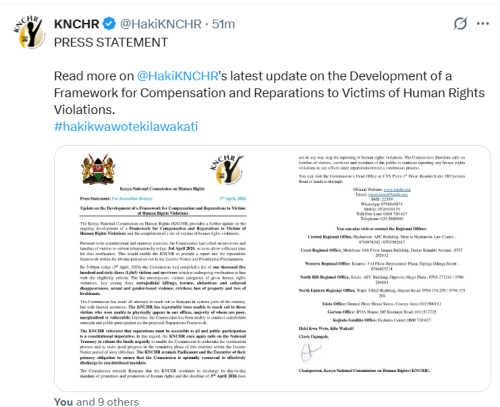
By Faith Lagat, April 3, 2026The Kenya National Commission on Human Rights (KNCHR) has compiled a list of 1,563 victims and survivors of gross human rights violations as the deadline for submissions closed on Friday, April 3, 2026.
The milestone forms part of the ongoing development of a national Framework for Compensation and Reparations following a Presidential Proclamation and Gazette Notice issued on March 6, 2026.
Acting under its constitutional and statutory mandate, the commission had called on survivors, families of victims and members of the public to submit information by 5:00 pm on April 3, 2026, to allow time for verification.
“By 5:00 pm today (3rd April, 2026), the Commission had compiled a list of one thousand five hundred and sixty-three (1,563) victims and survivors, which is undergoing verification in line with the eligibility criteria.
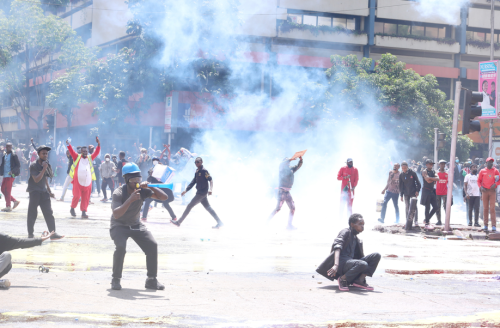
“The list encompasses various categories of gross human rights violations, key among them extrajudicial killings, torture, abductions and enforced disappearances, sexual and gender-based violence, evictions, loss of property and loss of livelihoods.”
According to KNCHR, the compiled list is now undergoing verification against eligibility criteria before the commission submits its report and proposed framework within the 60 days set out in the Gazette Notice.
Compilation of victims and categories of violations
The list includes victims and survivors from different parts of the country and covers a wide range of human rights violations. These include extrajudicial killings, torture, abductions and enforced disappearances, sexual and gender-based violence, evictions, loss of property and loss of livelihoods.
KNCHR said the exercise is part of a broader process aimed at documenting violations and establishing mechanisms for compensation and reparations.
The commission noted that the framework is expected to address different forms of redress, including restitution, rehabilitation and acknowledgement of wrongdoing.
KNCHR Chairperson Claris Ogangah said the exercise responds to a directive requiring the commission to compile the data and develop a framework for reparations within the specified timeline.
The commission is expected to present a comprehensive report once the verification process is complete.
Funding challenges and public participation
The commission said efforts were made to reach affected individuals across the country, but limited resources affected outreach to some victims, particularly those in remote areas.
KNCHR also noted that many victims who are poor, marginalised or vulnerable were unable to physically access its offices to submit information.
“Reparations must be accessible to all, and public participation is a constitutional imperative,” the Commission stated, while urging the National Treasury to release funds to support verification and the remaining stages of the process.
The commission also reminded Parliament and the Executive of their obligation to ensure independent institutions are adequately resourced to discharge their mandates.
Reporting of violations remains open
KNCHR clarified that the April 3, 2026, deadline applies only to the initial compilation for the current report and does not stop Kenyans from reporting human rights violations.
The Commission said reparations remain a continuous process, and members of the public can continue submitting information through its offices and official communication channels.
Victims and witnesses can contact the Commission through its head office in Nairobi, regional offices or through email, SMS, WhatsApp and toll-free lines provided by the institution.
KNCHR reiterated its commitment to the protection and promotion of human rights as the verification process continues.
As of Wednesday, April 1, 2026, the commission had identified at least 1,224 victims of human rights violations, including those linked to protests and demonstrations