KMPDU raises alarm over Kenya’s Ebola preparedness and health system gaps
By Kenneth Mwenda, May 30, 2026The Kenya Medical Practitioners, Pharmacists and Dentists Union (KMPDU) has warned that Kenya may not be ready to handle a possible Ebola outbreak, citing weak preparedness, staffing shortages, and gaps in critical care capacity.
In a statement on Saturday, May 30, 2026, the union questioned the government’s readiness to protect citizens as concerns grow over regional Ebola risks linked to outbreaks in the Democratic Republic of Congo and Uganda.
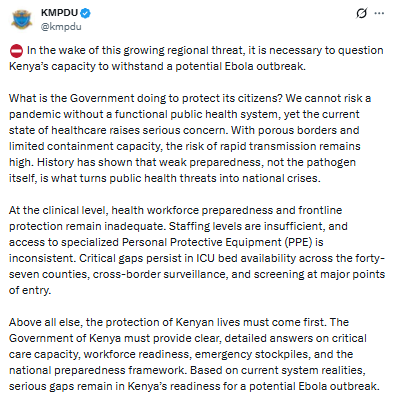
“In the wake of this growing regional threat, it is necessary to question Kenya’s capacity to withstand a potential Ebola outbreak,” the union said.
KMPDU said the government must explain what measures it has put in place to protect the public, warning that weak health systems often turn outbreaks into national crises.
“What is the Government doing to protect its citizens? We cannot risk a pandemic without a functional public health system, yet the current state of healthcare raises serious concern,” the union said.
Porous border issue
The doctors’ union warned that porous borders and limited containment capacity increase the risk of rapid spread if the virus enters the country. It said Kenya remains exposed due to gaps in surveillance and screening at key entry points.
“History has shown that weak preparedness, not the pathogen itself, is what turns public health threats into national crises,” KMPDU added.
The union also raised concern about frontline readiness, saying health workers continue to operate under difficult conditions. It pointed to shortages in staffing and inconsistent access to personal protective equipment (PPE).
“At the clinical level, health workforce preparedness and frontline protection remain inadequate. Staffing levels are insufficient, and access to specialised Personal Protective Equipment is inconsistent,” the statement read.
KMPDU further highlighted weaknesses in intensive care capacity across the country’s 47 counties, saying many hospitals lack sufficient ICU beds and emergency equipment to handle severe infectious disease cases.
“Critical gaps persist in ICU bed availability across the forty-seven counties, cross-border surveillance, and screening at major points of entry,” the union said.
The statement comes at a time when debate has intensified over Kenya’s role in regional Ebola preparedness, including reports of possible arrangements involving isolation or treatment facilities linked to foreign partners.
Focus on outbreak source
The union has opposed any move to establish such facilities locally, arguing that containment efforts should focus on the outbreak’s source in the Democratic Republic of Congo rather than shifting risk to other countries.
KMPDU Secretary General Davji Atellah said regional response should prioritise the epicentre of the outbreak.
“The best way of containment of any outbreak is through the epicentre; the point of the outbreak, like in Congo,” he said.
He added that ongoing conflict in eastern DRC has made containment more difficult and called for stronger international support to control the spread at its source.
“We have seen the disease spreading at a very high rate in Congo, particularly because of the war that has been ongoing in that particular country,” Atellah said. “We ask our government and regional governments that there should be more resources and experts being sent to Congo to help the containment.”
Atellah also challenged the government to publish full details of Kenya’s preparedness plan, including emergency stockpiles, workforce readiness, and critical care capacity.
“The government of Kenya must provide clear, detailed answers on critical care capacity, workforce readiness, emergency stockpiles, and the national preparedness framework,” he said.
He warned that serious gaps still exist in Kenya’s ability to respond to a major outbreak, despite official assurances of preparedness.
“Based on current system realities, serious gaps remain in Kenya’s readiness for a potential Ebola outbreak,” he said.
The concerns have also entered the political and legal space, with several leaders and organisations questioning reported plans related to Ebola isolation or treatment arrangements in Kenya. A High Court ruling has temporarily blocked any such facility pending further hearings.
The Ministry of Health has said Kenya remains on high alert and continues to strengthen surveillance and screening at entry points. It has also stated that any international cooperation will follow national laws and public health safeguards.
However, KMPDU maintains that without urgent investment in health systems, Kenya risks facing serious challenges in the event of an outbreak.
Above all, the union said the government must prioritise the protection of Kenyan lives and address long-standing weaknesses in the health sector before considering any new arrangements.
“Above all else, the protection of Kenyan lives must come first,” the union said.