Advertisement
Kenya Space Agency announces launch of AI-powered climate camera to ISS
Saturday 11th April, 2026 10:05 PM|
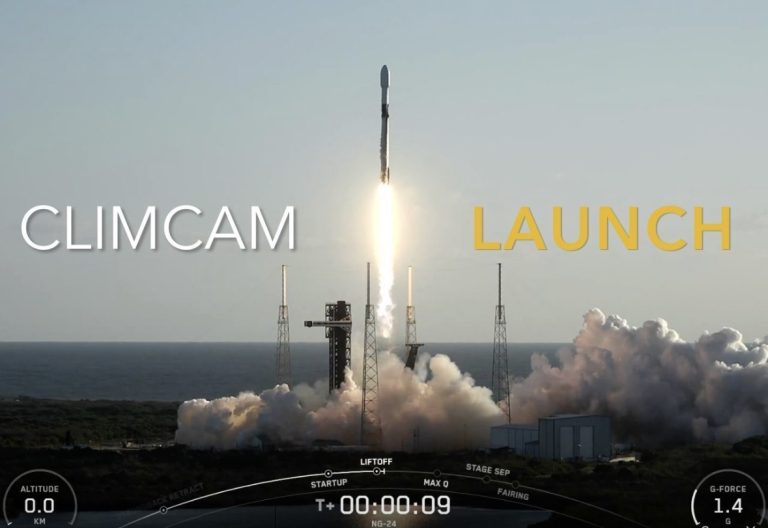
The Kenya Space Agency (KSA) has announced the successful launch of an artificial intelligence-powered Climate Camera (ClimCam) payload to the International Space Station, marking a major milestone for Kenya and the wider East African region in space technology and innovation.
KSA, in a statement issued on Saturday, April 11, 2026, said the ClimCam payload was launched aboard SpaceX Falcon 9 as part of Northrop Grumman’s Cygnus XL commercial resupply mission (NG-24).
The liftoff took place from Cape Canaveral Space Force Station in Florida on Saturday, April 11, 2026, at 1:41 pm.
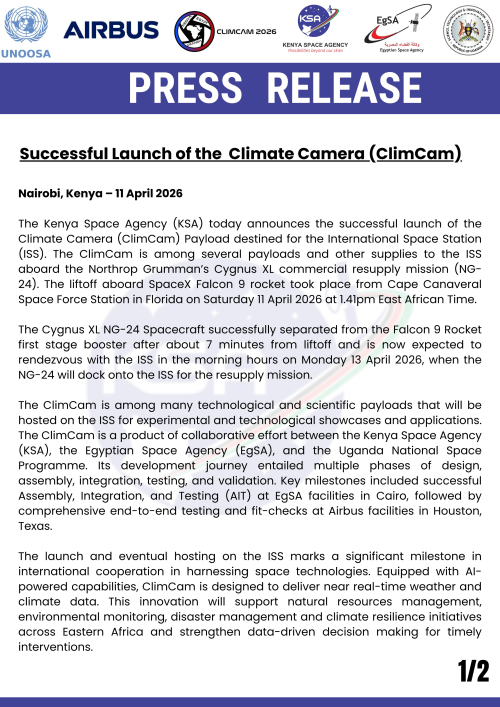
“The Kenya Space Agency (KSA) today announces the successful launch of the Climate Camera (ClimCam) Payload destined for the International Space Station (ISS). The ClimCam is among several payloads and other supplies to the ISS aboard the Northrop Grumman’s Cygnus XL commercial resupply mission (NG-24). The liftoff aboard SpaceX Falcon 9 rocket took place from Cape Canaveral Space Force Station in Florida on Saturday, 11 April 2026, at 1.41pm East African Time,” the statement reads in part.
You Might Also Like


According to KSA, the Cygnus XL spacecraft successfully separated from the Falcon 9 rocket approximately seven minutes after liftoff and is now en route to the ISS. The spacecraft is expected to dock with the orbiting laboratory on Monday, April 13, 2026, where it will deliver supplies and scientific payloads, including ClimCam.
The mission forms part of ongoing global efforts to advance scientific research and technological demonstrations aboard the ISS.
“The Cygnus XL NG-24 Spacecraft successfully separated from the Falcon 9 Rocket first stage booster after about 7 minutes from liftoff and is now expected to rendezvous with the ISS in the morning hours on Monday 13 April 2026, when the NG-24 will dock onto the ISS for the resupply mission,” KSA stated.
“The ClimCam is among many technological and scientific payloads that will be hosted on the ISS for experimental and technological showcases and applications.”
African collaboration
ClimCam is the result of a joint effort between the Kenya Space Agency, the Egyptian Space Agency, and the Uganda National Space Programme.
Its development involved multiple phases, including assembly, integration, and testing at Egyptian Space Agency facilities in Cairo, followed by advanced testing and fit-checks at Airbus facilities in Houston, Texas.
The project was selected under a competitive opportunity issued by the United Nations Office for Outer Space Affairs in partnership with Airbus Defence and Space, as part of the Access to Space for All initiative.
Real-time climate monitoring
Equipped with artificial intelligence capabilities, ClimCam is designed to provide near-real-time weather and climate data. The system is expected to play a critical role in environmental monitoring, natural resource management, disaster response and early warning systems, and climate resilience planning.
Officials say the data generated will support evidence-based decision-making across Eastern Africa, helping governments and agencies respond more effectively to climate-related challenges.
“The consortium constituting the Kenya Space Agency, the Egyptian Space Agency and Uganda National Space Programme emerged successful winners of a competitive Announcement of Opportunity (AO) issued by the United Nations Office for Outer Space Affairs (UNOOSA), in partnership with Airbus Defence and Space, as part of the Access to Space for All initiative, requiring consortiums to develop a payload that would be flown on the Airbus platform in the ISS,” the statement read.
“Beyond its scientific and technological impact, ClimCam exemplifies African collaboration in the space sector. The mission integrates expertise in space systems engineering, Earth observation, artificial intelligence, and data analytics, showcasing the continent’s growing capacity to develop transformative space technologies.”
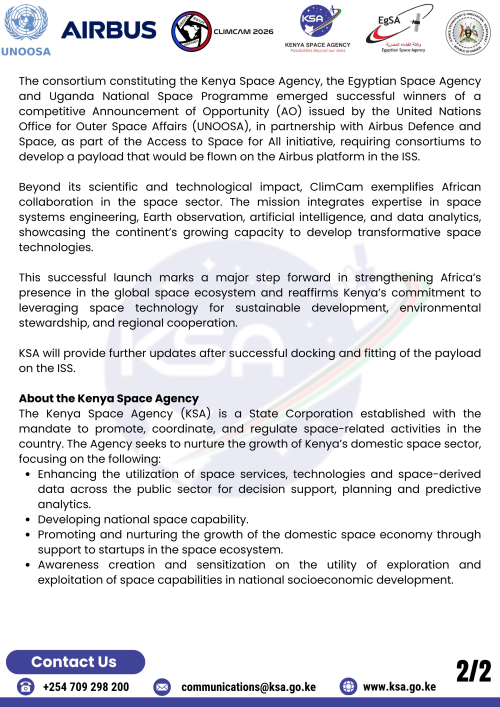
KSA described the launch as a significant step forward in strengthening Africa’s presence in the global space ecosystem.
Beyond its scientific value, the mission highlights growing collaboration among African nations in space engineering, Earth observation, and data analytics.
The Kenya Space Agency is expected to provide further updates once the payload is successfully docked and installed aboard the ISS.
Author
Mustafa Juma
View all posts by Mustafa JumaLatest News








Advertisement
More on News