Kenya issues safety alert for citizens in South Africa amid rising xenophobic violence
By Aloys Michael, May 4, 2026Kenyans residing in South Africa have been advised to remain vigilant after new safety concerns emerged, with authorities warning of heightened tensions and isolated cases of hostility toward foreign nationals in certain areas.
In an advisory released on Monday, May 4, 2026, the Kenya High Commission in Pretoria urged Kenyan citizens, many of whom are employed, studying, or running businesses in South Africa, to exercise caution amid growing unease linked to sporadic protests and demonstrations in parts of the country.
“The Kenya High Commission in Pretoria wishes to advise all Kenyan nationals residing in the Republic of South Africa to exercise caution and remain vigilant in light of recent demonstrations and isolated incidents reported in some parts of the Republic of South Africa affecting foreign nationals,” the statement read in part.
The High Commission further warns Kenyans to avoid, as far as possible, areas where protests or demonstrations may be taking place, and to remain attentive to guidance issued by local authorities.
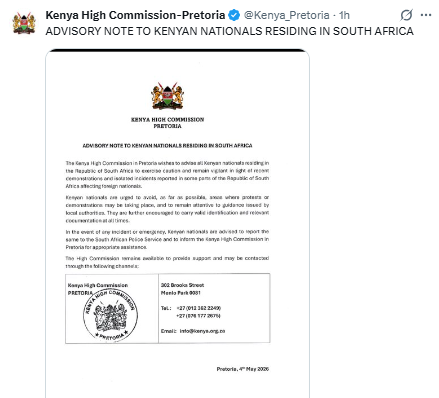
The High Commission also urges the more than 40,000 Kenyan nationals residing in South Africa to always carry valid identification and the necessary documents, and to remain prepared to avoid being caught in unexpected tense situations.
In addition, Kenyans in South Africa are encouraged to maintain regular contact with local security authorities and promptly report any incidents or threats directed against them.
“In the event of any incident or emergency, Kenyan nationals are advised to report the same to the South African Police Service (SAPS) and to inform the Kenya High Commission in Pretoria for appropriate assistance,” urged the High Commission.

South Africa’s xenophobic violence
South Africa has experienced a sharp resurgence of xenophobic violence in late April and early May 2026, with mobs attacking foreign nationals across Johannesburg, Cape Town, and the Eastern Cape provinces.
Armed vigilante groups have looted and destroyed foreign-owned businesses, displacing over a thousand immigrants in Durban alone. Nationals from Nigeria, Ghana, Zimbabwe, Malawi, and Lesotho have been among the hardest hit.
Operation Dudula and similar groups have been leading protests demanding the expulsion of foreign nationals, blaming migrants for rising unemployment, crime, and drug abuse amid South Africa’s deepening economic difficulties.
Local political figures and community leaders have been accused of worsening tensions by spreading anti-immigrant narratives, which is reported to risk unfairly blaming foreign nationals for deep-rooted economic challenges they did not cause.
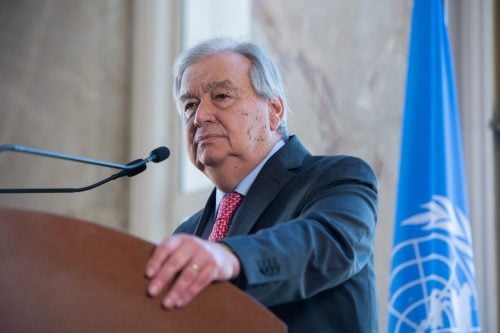
Global criticism of the xenophobic violence has intensified, with UN Secretary-General António Guterres emphasising that such acts of hatred stand in stark contrast to the international solidarity once shown to South Africa during its anti-apartheid struggle.
In response, Nigeria recalled its envoy and arranged evacuations for its citizens, while Ghana and Zimbabwe called for enhanced protection of migrants. The African Commission on Human and Peoples’ Rights (ACHPR) has also pressed for swift investigations and the prosecution of those responsible.
Meanwhile, regional and international human rights organisations, including Amnesty International, have warned that the attacks threaten efforts toward African unity and risk undermining South Africa’s standing as a key regional advocate for peace, democracy, and inclusive development.