Kenya Finance Bill 2026/27 does not reflect public will – Gachagua
By Faith Lagat, June 5, 2026Former Deputy President Rigathi Gachagua has criticised the proposed 2026/27 Budget Estimates and Finance Bill, arguing that they do not reflect the priorities of ordinary Kenyans and could deepen fiscal pressure through increased borrowing.
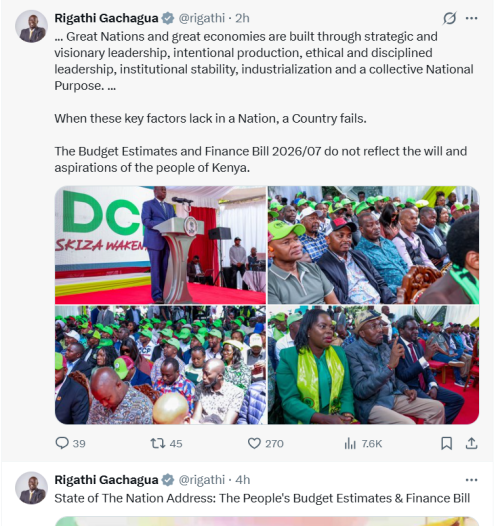
Speaking during a “State of the Nation Address: The People’s Budget Estimates & Finance Bill” event under the Democracy for the Citizens Party (DCP) banner, Gachagua called on Parliament and the public to reject the proposals, saying national planning must be grounded in production, accountability, and realistic economic projections.
Revenue projections and debt burden questioned
Gachagua faulted what he termed unrealistic revenue targets, noting that government collections have consistently fallen short of projections for three consecutive years. He argued that continued reliance on inflated estimates has been used to justify new taxes and levies.
“The Treasury must align revenue projections with actual economic performance and stop using unrealistic targets to justify new taxes and levies,” he said, adding that budgets should be based on verifiable economic data.
He also raised concern over the proposed fiscal deficit of about Ksh 1.144 trillion, stating that it would be financed through additional borrowing despite Kenya’s public debt standing at approximately Ksh 13 trillion. He further noted that debt servicing already consumes a significant share of government revenue.
Calls for production-focused economic model
Gachagua said Kenya’s economic planning should prioritise productivity, agriculture, healthcare access, education quality, and affordable credit for businesses rather than expanding public expenditure.
“Economic growth is not created by slogans,” he said. “Growth comes from productivity, predictable policy, trust between the state and citizens, and a government that spends with restraint and plans with honesty.”
He added that the budget should focus on empowering citizens including farmers, youth, teachers, healthcare workers, entrepreneurs, police officers, and civil servants, rather than expanding bureaucracy.
Parliament scrutiny and ongoing debate
The remarks come as Parliament continues reviewing the Finance Bill ahead of the national budget presentation. Public participation sessions on the bill have attracted mixed reactions, with Treasury officials defending the proposals as necessary for widening the tax base and supporting development priorities.
Other political leaders have also weighed in on the debate, with opposition figures raising concerns over the potential impact of new taxation measures on households and businesses.