Advertisement
Kemri carrying out trials on special porridge to de-worm children
Monday 12th July, 2021 12:00 AM|
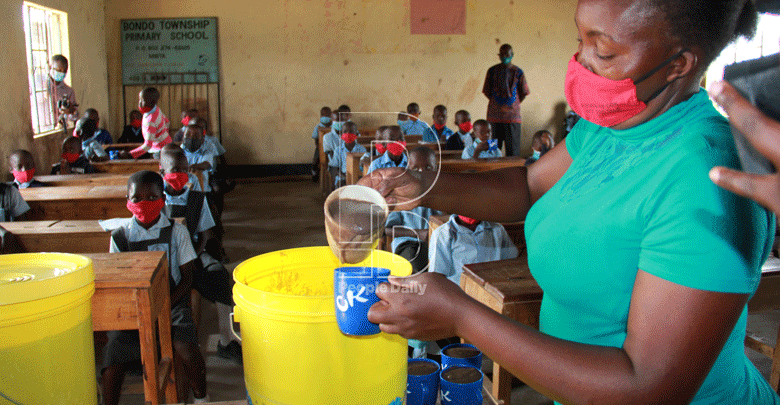
The Kenya Medical Research Institute (Kemri) is banking on the success of trials on herbal flour to find a breakthrough in the treatment of neglected tropical diseases.
Scientists at the research agency are undertaking a study on nutritious porridge for de-worming of children.
The Ujiplus Project, which is undergoing a third clinical trial, aims at providing a local solution in the cure of intestinal problems such as infections roundworms, hookworms, schistomomiasis (bilharzia) and ring worms.
Researchers say the herbal flour, taken in form of integrated porridge, could boost immune system of the children to be able to fight tropical infections.
The culmination of the third clinical trial is expected to determine whether the new product will be introduced to the market to be used as an alternative curative measure to the neglected tropical diseases such as bilharzia.
Ujiplus flour porridge is cooked just like any other porridge.
The Ujiplus project, which is being piloted in four primary schools that border Lake Victoria in Suba North sub-county, Homa Bay County is aimed at protecting children from bacteria and fungal skin infections.
Prof Elijah Songok, a director for research capacity building at Kemri, said the research could be headed for a breakthrough following positive indicators in the previous trials.
Alternative formula
Songok revealed that preliminary clinical trials of the herbal medicine were done in Nandi and Kirinyaga counties where children were given the porridge for two months.
“The outcome of the trial met our result objectives, raising hopes of possible success in the study.
Children who took the porridge were de-wormed and their nutritional indicators (weight) improved,” he said.
Speaking at Bondo area in Mbita town at the weekend, he noted that the invention which focuses on designing an alternative formula for de-worming is not only effective, safe and affordable but also enhances child nutrition.
The intestinal worm infections are rampant in areas around large water bodies.
He said drugs used in de-worming such as praziquantel and albendazole were not recommended for children below two years.
“We are hoping the local herbal innovation will change the approach to child de-worming in Africa,” he said.
Dr Elizabeth Matey, a scientist at Kemri and one of the researchers behind the invention of the product, said the porridge flour is made from home-grown ingredients such as millet, maize and other fortified products.
“We have partnered with herbalists and farmers who are the suppliers of the ingredients which have been tested in our laboratories,” Matey said.
Preliminary results showed that some schools in the area where the de-worming flour trials were done, signs of health improvement were reported among learners initially predisposed to tropical infections.
Prior to piloting of the program by Kemri, the government had been undertaking nationwide de-worming exercise that started in 2001.
Author
Latest News







Advertisement
More on News
