KCSE 2025: Omtatah writes to KNEC over claims of discrimination
By Aloys Michael, January 14, 2026Busia Senator Okiya Omtatah has challenged the Kenya National Examinations Council (KNEC) over the handling of Kenya Sign Language (KSL) in the 2025 Kenya Certificate of Secondary Education (KCSE) examinations, calling for an urgent regrading of the results.
He argues that the current grading system unfairly disadvantages certain categories of candidates.
In a letter to KNEC Chief Executive Officer David Njeng’ere, received on January 13, 2026, the senator questioned the methodology used to factor KSL into the computation of candidates’ final mean grades, citing what he described as discriminatory inconsistencies.
“Exams must be fair. Rules cannot change after the fact,” the letter read in part.
The senator stated that while KNEC classifies KSL as a technical subject under Category 5 of the 8-4-4 curriculum, its grading was applied inconsistently across candidates who sat the 2025 KCSE.
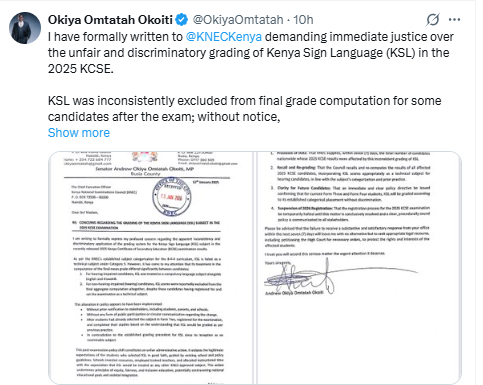
According to Omtatah, KSL was treated as a compulsory language subject for hearing-impaired candidates, alongside English and Kiswahili; however, it was excluded from the final aggregate score for hearing candidates who had registered for and sat the examination as a technical subject.
“As per the KNEC’s established subject categorization for the 8-4-4 curriculum, KSL is listed as a technical subject under Category 5. However, it has come to my attention that its treatment in the computation of the final mean grade differed significantly between candidates,” he said.
“For hearing-impaired candidates, KSL was treated as a compulsory language subject alongside English and Kiswahili. For non-hearing-impaired (hearing) candidates, KSL scores were reportedly excluded from the final aggregate computation altogether, despite these candidates having registered for and sat the examination as a technical subject.”
According to the Senator, the exclusion was effected without advance notice, public participation, or the issuance of any formal circular to schools, parents, or candidates, despite students having selected the subject in Form Two and pursued it with the expectation that it would be graded.
He further observed that the decision departed from the long-standing grading framework applied to KSL since KNEC first made it an examinable subject.
Omtatah said the post-examination policy shift violated fairness and legitimate expectations, unfairly disadvantaging candidates and schools that had invested in KSL teachers and instruction under the existing guidelines.
“This post-examination policy shift constitutes an unfair administrative action. It violates the legitimate expectations of the students who selected KSL in good faith, guided by existing school and policy guidelines,” the letter read.
“Schools invested resources, employed trained teachers, and allocated instructional time with the expectation that KSL would be treated as any other KNEC-approved subject. This action undermines principles of equity, fairness, and inclusive education, potentially contravening national educational goals and societal integration.”

Omtatah’s demands
In the letter, he demanded that KNEC provide data within seven days on the total number of candidates affected by the inconsistent grading of KSL in the 2025 KCSE.
He has also called for the recall and recomputation of examination results for all affected candidates, adding that KSL should be included as a technical subject for hearing-impaired students, consistent with its recognised classification.
In addition, Omtatah urged KNEC to issue an immediate policy directive to clarify how KSL will be graded for current Form Three and Form Four students in upcoming examinations.
He further recommended that the council temporarily suspend registration for the 2026 KCSE exams until the issue is resolved, warning that failure to take action within seven days could lead him to seek legal action through the High Court.