Advertisement
JSC intensifies anti-corruption reforms following gender and corruption survey findings
Monday 13th April, 2026 12:53 PM|

The Judicial Service Commission (JSC) has renewed its efforts to enhance integrity in the justice sector in the wake of the publication of the Kenya National Gender and Corruption Survey 2025.
The survey, conducted across the public service, assessed corruption patterns and the effectiveness of current interventions to combat corruption.
In a statement on their X handle on Monday, April 13, 2026, after an engagement with the officials of the Ethics and Anti-Corruption Commission (EACC), JSC affirmed the commitment, saying that the meeting was the beginning of an organised process that would help translate the recommendations into specific reforms in the judiciary.
The meeting, which was headed by the Chief Registrar of the Judiciary and Secretary to the JSC, Winfridah Mokaya, was meant to examine the findings of the report.
You Might Also Like



“The meeting started a planned review of the report’s findings and recommendations, which will guide specific actions to improve the Judiciary’s ongoing reforms focused on increasing integrity, transparency, and accountability in the justice system,” the JSC statement said in part.
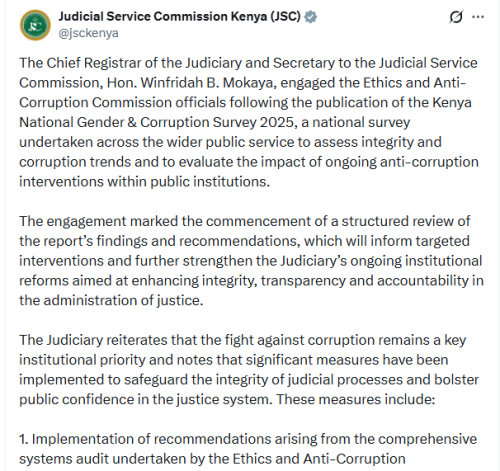
The JSC says that the review will be instrumental in promoting transparency, accountability and integrity in the judicial system. The Commission observed that combating corruption is a top institutional agenda and that some steps have already been taken in this regard to protect the delivery of justice and enhance societal trust.
Some of the major reforms identified include adopting recommendations of a thorough system audit carried out by the EACC and ongoing verification of compliance within the court registries and departments. Another measure that the judiciary has been undertaking towards anti-corruption efforts is the setting up of integrity committees in every court station to streamline anti-corruption efforts and enhance oversight.
Moreover, the JSC highlighted the need to involve stakeholders via Court Users Committees and the Bar-Bench forums in cooperation with the Law Society of Kenya. These websites are meant to enhance accountability, responsiveness, and service delivery in the courts.
JSC efforts to curb corruption
In an effort to reduce corruption at the operational level, the judiciary has also initiated daily court briefings to sensitise the litigants and caution against the use of brokers and also reiterate the zero tolerance of corruption.
It has also completely digitised the payment systems by using e-payment and e-receipting systems, where the payment processes and receipting processes in courts have been eliminated.

Other protective measures include staff identification to thwart impersonation and improvements in complaints management by the Office of the Judiciary Ombudsman.
Mokaya highlighted that combating corruption should be done through long-term and concerted actions between institutions. She reiterated the commitment of the judiciary to collaborate with the EACC and other oversight institutions to promote a transparent, accountable and corruption-free justice system.
The JSC once again stated that it is committed to promoting institutional changes at all times and that justice is administered in accordance with the highest standards of integrity, professionalism and public trust.
Author
Latest News








Advertisement
More on News