Advertisement
In Bartabwa, network coverage is a matter of life and death
Thursday 13th May, 2021 12:00 AM|
Wycliff Kipsang
Situated 60km north of Kabarnet town in Baringo, Bartabwa trading centre is a troubled area.
When not dealing with banditry and cattle rustling, residents will most likely be smarting out of tribal clashes.
But that’s not all that defines the area. It is one of Kenya’s regions that have poor and at times no access to mobile phone network.
Poor communication network in Bartabwa is particularly experienced when bandits strike, when residents most need the services of security agencies; and who can’t be reach, giving bandits a field day to terrorise residents.
Last week, a middle-aged man was attacked by armed bandits in Kapturo village.
Although he survived the attack, getting an ambulance to take him to the hospital was a real challenge.
In fact, someone had to literally run to the next Health centre to pass the message.
Ruto rally interrupted
“The criminals know there is no network coverage in this area that is why they ambush people and attack them at will,” Andrew Chebelieny, a resident, told People Daily in an interview.
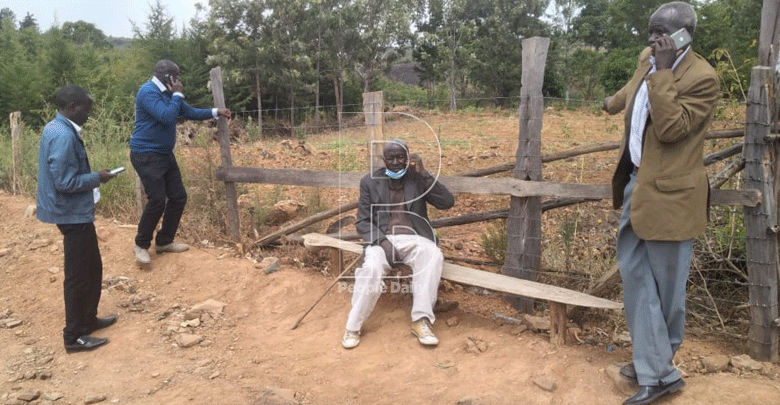
A spot check at Bartabwa trading centre alone, where the Assistant County Commissioner’s office is located, revealed emergency response is virtually impossible due to lack of network coverage.
Adjacent to the office is the 20-bed capacity Bartabwa Health Centre, a primary school and Arap Moi Secondary School.
On February 23, 2017, daring bandits staged an attack in broad daylight just a few kilometres from where Deputy President William Ruto was addressing a political rally.
The DP had to cut short his speech following a hail of gunshots from a nearby thicket as residents scampered for safety.
Unknown to the DP’s security detail, the Ng’orora location chief Thomas Chelegen had been shot dead by suspected bandits.
The chief was leading a team of Kenya Police Reservists who had responded to the attack in a nearby village.
It later emerged he tried to run for his life but lost contact with his patrol team when he was fatally shot.
It was impossible for him to contact them or even send a text message while in his hideout.
A security officer said the chief could have been rescued if the area had network coverage. “The chief died a painful death.
The lack of mobile network made things worse for him because he could have called and we would have responded,” a police officer who was in the administrator’s team said.
M-Pesa services
The poor network coverage is also affecting education in the area. During the prolonged Covid-19 school holiday, learners in the area could not access online learning.
Teachers in Bartabwa also find it difficult filing their periodic returns on time.
According to Bartabwa Day and Boarding Primary School head teacher Willy Lang’at, they are forced to travel to Kipsaraman town, some 19km away to access Internet services.
“We incur a lot of expenses travelling just to remit teacher lesson booking, lesson observation and to file KRA returns among other requirements,” said Lang’at.
Businesspeople have had fair share of their frustrations too.
Kaino Cheserek, a businessman in the area, says while mobile phone money services have become the lifeline of business and engine of growth in Kenya, such service are non-existent in the area.
“Those who want to access to M-Pesa services have to travel some 19km,” he said.
Author
People Reporter
View all posts by People ReporterLatest News







Advertisement
More on News