Govt lists hotspots for illicit alcohol as crackdown nets 2.8 million litres
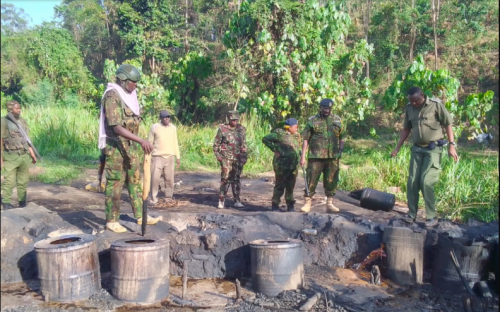
By Ndiritu Wanjiru, April 15, 2026Kenya has stepped up the crackdown on illicit brews and spirits throughout the country, with multi-agencies enforcing their operations under the guidance of NACADA Kenya, which led to a seizure of some 2.8 million litres of illicit brews and spirits all around the country.
Confirming the crackdown in an X post on Wednesday, April 15, 2026, the Ministry of Interior and National Coordination says that the operation is a subset of a larger government directive that categorises drug and substance abuse as a national development and security emergency.
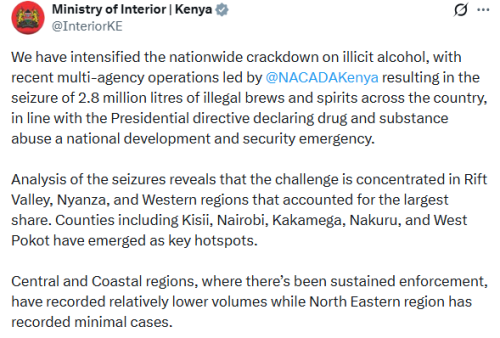
“We have intensified the nationwide crackdown on illicit alcohol, with recent multi-agency operations led by @NACADAKenya resulting in the seizure of 2.8 million litres of illegal brews and spirits across the country, in line with the presidential directive declaring drug and substance abuse a national development and security emergency,” the Ministry of Interior stated.
The ministry has further added that the crackdown is aimed at breaking down production and distribution networks for illicit alcohol that are still posing threats to people’s health and social stability.
Initial examination of the confiscations reveals that the Rift Valley, Nyanza and Western regions have the highest concentration of the problem, with the highest proportion of illicit alcohol seized.
Key hotspot areas on illicit brewing
Some counties identified as very hot spots include Kisii, Nairobi, Kakamega, Nakuru, and West Pokot. These regions are among the main areas where enforcement continues due to ongoing illicit brewing.
The seizure analysis indicates that the Rift Valley, Nyanza, and Western regions face the greatest challenge, accounting for the largest share. Counties including Kisii, Nairobi, Kakamega, Nakuru, and West Pokot have emerged as key hotspots,” the Ministry of Interior added.
Nairobi has also emerged as a hotspot, highlighting the urban aspect of the illicit alcohol business, where distribution channels often overlap with informal settlements and unauthorised outlets.
By contrast, Central and Coastal areas have registered comparatively small amounts of illicit alcohol seizures, which, according to authorities, is attributed to the continuous enforcement operations and the continued publicity campaigns. Minimal cases have been reported in the northeastern region, which means that the illicit brewing activities are not prevalent there.
The government has asserted that the multi-agency strategy will be maintained, although more surveillance, intelligence-based operations, and community involvement are likely to disrupt supply chains and limit the supply of illegal alcohol in the country.