Govt lists 36 specialised healthcare services not available in Kenya
By Faith Lagat, September 20, 2025The Ministry of Health has issued a Gazette Notice outlining 36 specialised healthcare services not available in Kenya, paving the way for Kenyans to seek treatment abroad under the Social Health Insurance (SHI) scheme.
Managed by the Social Health Insurance Authority (SHA), the programme will finance up to Ksh500,000 per beneficiary for procedures unavailable locally.
Gazette Notice No. 13369, dated September 18, 2025, was published pursuant to Regulation 39 (1)(b) and Regulation 49 (1) and (2) of the Social Health Insurance Regulations, 2024.
Also watch: “Kenya is transforming, and that is why every Kenyan matters” – Ruto
In it, Cabinet Secretary for Health Hon. Aden Duale, in consultation with the SHA and on the recommendation of the Benefits Package and Tariffs Advisory Panel (BPTAP), gives notice to the public of the list of services not available in Kenya.
“PURSUANT to the provisions of Regulation 39 (1) (b) and Regulation 49 (1) and (2) of the Social Health Insurance Regulations, 2024, the Cabinet Secretary for Health, in consultation with the Social Health Authority and on the recommendation of the Benefits Package and Tariffs Advisory Panel (BPTAP), gives notice to the public of the list of healthcare services not available in Kenya as set out in the Schedule,” read part of the notice.
Services identified and reasons
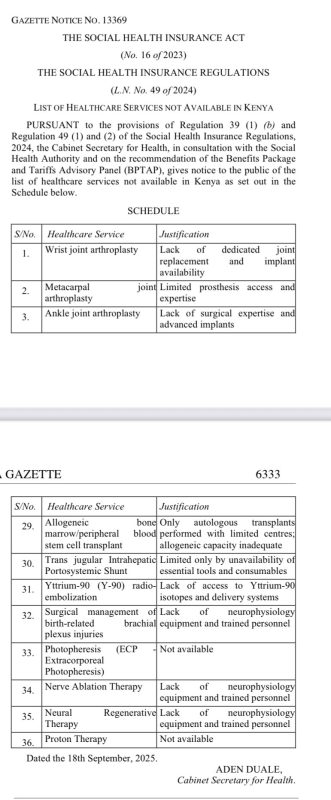
The schedule includes procedures such as wrist joint arthroplasty, metacarpal joint surgery and ankle joint arthroplasty, citing a “lack of dedicated joint replacement and implant availability” and “limited prosthesis access and expertise”.
Also listed are allogeneic marrow or peripheral stem cell transplants, transjugular intrahepatic portosystemic shunt, yttrium-90 (Y-90) radioembolisation, surgical management of birth-related brachial plexus injuries, extracorporeal photopheresis, nerve ablation therapy, neural regenerative therapy and proton therapy.
Each service is accompanied by a justification, such as “only autologous transplants performed with limited centres, allogeneic capacity inadequate” for stem cell procedures, “limited by unavailability of essential tools and consumables” for shunt procedures, or “lack of neurophysiology equipment and trained personnel” for nerve therapies.
Eligibility
In a press release earlier, Duale stated, “The maximum limit payable for overseas treatment/procedures is capped at KES 500,000, subject to review upon completion of contracting and rate negotiations with accredited providers abroad.”
He added that the Ministry of Health, through SHA, is “proud to announce a new era for specialised medical care for all Kenyans under the SHI scheme.”
According to the notice, eligibility requires that the beneficiary’s contributions are up-to-date and that the service sought is not available locally. Overseas facilities must be accredited in their home country and recognised by Kenyan regulatory bodies, with a mandatory link to a local contracted facility for follow-up care. Referrals will undergo peer review by the Claims Management Office to confirm medical necessity, and the treatment must not be experimental or unconventional.
The BPTAP developed the initial list and will continue health technology assessments to identify further interventions.