Government unveils Ksh4.9T asset portfolio amid reforms
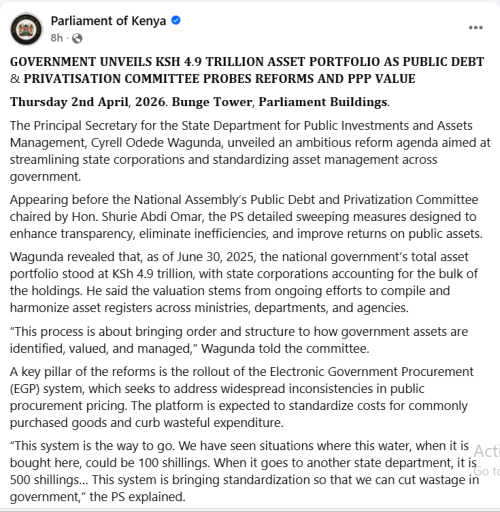
By Faith Lagat, April 3, 2026The Kenyan government has taken a major step towards transparency and efficiency in public asset management, unveiling a national asset portfolio valued at Ksh4.9 trillion as of June 30, 2025.
Principal Secretary for the State Department for Public Investments and Assets Management, Cyrell Odede Wagunda, revealed the figures while appearing before the National Assembly’s Public Debt and Privatisation Committee, chaired by Shurie Abdi Omar on April 2, 2026.
“This process is about bringing order and structure to how government assets are identified, valued, and managed,” Wagunda told the committee.
He explained that state corporations form the bulk of the holdings and that the valuation exercise marks a key move towards accountability in managing public resources.
Reforms target efficiency and transparency
Wagunda outlined an ambitious reform agenda to streamline state corporations, harmonise asset registers across ministries, departments, and agencies, and improve returns on public investments.
A central feature is the rollout of the Electronic Government Procurement (e-GP) system, aimed at eliminating inconsistencies in procurement pricing.
Wagunda cited examples where the same item, such as water, cost Ksh100 in one department and Ksh500 in another. The e-GP system will standardise pricing for commonly purchased goods and services, reducing waste and improving value for money across government operations. Officials said the platform is expected to promote transparency and reduce inefficiency in procurement processes.
The first phase of state corporation reforms will merge 23 entities into nine new government-owned enterprises while dissolving 16 others, including six regional development authorities. The restructuring aims to eliminate duplication, reduce administrative costs, and boost operational efficiency in line with broader fiscal consolidation efforts.
Lawmakers call for oversight on PPP projects
Committee chair Shurie Abdi Omar welcomed the reforms but stressed the need for robust oversight, especially on large-scale infrastructure projects delivered through Public-Private Partnerships (PPPs).
“I personally wish to visit the site so that it will be good for us to see so that when I’m told this PPP project is done, then I can confidently stand on the floor of the House and say yes,” he said.
Lawmakers also questioned whether PPPs are delivering value for taxpayers. Hon. Daniel Manduku asked about the cost-effectiveness of some agreements given current market trends.
Wagunda and officials from the PPP Directorate said all projects undergo feasibility studies and lifecycle-based value-for-money assessments that compare PPP models with traditional procurement.