Gachagua promises to compensate Mau Forest evictees in six months if United Opposition wins in 2027
By Ndiritu Wanjiru, February 23, 2026Members of the United Opposition, led by the former Deputy President and the party leader for the Democracy for the Citizens Party (DCP), have promised to pay compensation to the families displaced in the Mau Forest in the event it takes power in the upcoming 2027 general election.
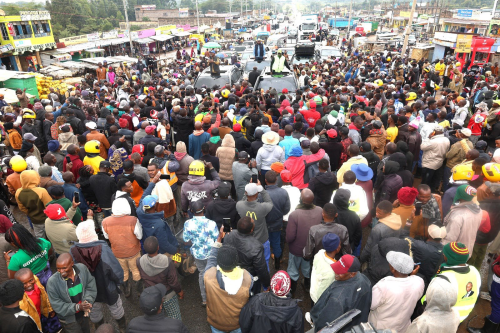
Speaking at Mulot, in Bomet County, on Monday, February 23, 2026, the united opposition leaders promised to make it a priority to compensate the victims of the Mau Forest evictions as the first thing when the united opposition takes power.
“Watu wale walitolewa Mau wapewe pesa yao waanze maisha upya, na mimi nataka kuwahakikishia tukichukua serikali tukiwa na huyu Kalonzo within the first six months tutalipa hawa watu waanze maisha,” Rigathi said.

Loosely translated as “Those who were evicted from Mau Forest should be compensated to start life afresh, and I want to assure you that once we are elected in office next year, we shall compensate the victims in the first 6 months in office.”
Between 2004 and 2006, a massive programme of evictions was carried out in the forest areas of Kenya. Houses, schools and health centres have been destroyed, and many have been rendered homeless.
About Mau evictions
Estimates from the Kenya National Commission on Human Rights (KNHCR) indicate that in six forests alone, more than a hundred thousand persons were forcibly evicted between July 2004 and June 2006. Evictions in many forest areas are reportedly continuing, and humanitarian groups are expressing growing concerns about the ongoing increase in internally displaced persons from forest areas in Kenya.
East Africa has one of the largest water towers, known as the Mau Forest, which has been the subject of discussions of environmental conservation over the decades.
Eviction exercises, especially by the government, when the Environment and Land Court decisions ruled in favour of the legality of the boundary of forests instituted in 2001, have caused displacement and humanitarian issues.
In October 2006, a coalition of national and international human rights organisations including Amnesty International, the Centre on Housing Rights and Evictions (COHRE), Hakijammi and the Kenya Land Alliance, undertook a fact-finding mission to two areas of the Mau Forest Complex to investigate the extent of forced evictions and other related human rights violations.
The Kenya National Commission on Human Rights, an independent national human rights institution of the Government of Kenya, accompanied the mission. The mission to Mau Forest is also part of a wider program of research and advocacy being undertaken in Kenya by civil society organisations and KNCHR on forced evictions.
The partnering organisations are concerned that future plans for forest evictions do not incorporate a rights-based approach and that the impact of such action will fall heaviest on people living in poverty in Kenya.
The Government of Kenya promised the United Nations in March 2005 (more than two months before the Mau Forest evictions accelerated) that it will ensure that all future evictions comply with international human rights standards, but there are still no concrete guidelines or laws at the national level, or policies and programmes within the Ministry of Environment, that ensure that these standards will be respected.
Compensation has been a matter of debate every now and then, particularly in the election years, where contentious land issues have been known to be highly political. The community leaders and the human rights agencies have demanded better resettlement policies and, in some cases, financial redress.
The United Opposition side has included a compensation promise to evictees of the Mau Forest in the official 2027. The announcement has been seen to escalate domestic politics before 2027, and the land reform seems to be a theme to woo the people in the region considered to be the backyard of the current president, William Ruto.