Finance Bill 2026: MPs seeks balance between revenue mobilisation and taxpayer relief
By Ndiritu Wanjiru, June 17, 2026The National Assembly’s Departmental Committee on Finance and National Planning has tabled its report on the Finance Bill 2026, proposing a series of amendments aimed at striking a balance between enhancing government revenue collection and protecting taxpayers from excessive tax burdens.
The Parliament noted that the report, presented by Finance Committee Chairperson and Molo MP Kuria Kimani on Wednesday, June 17, 2026, follows an extensive public participation exercise that attracted more than 100,000 submissions and public hearings held across 13 counties.
“The report was tabled following a rigorous public participation process that included receiving memoranda from over 100,000 respondents and conducting public hearing forums across thirteen counties to gather the views of the members of the public,” the national Assembly stated.
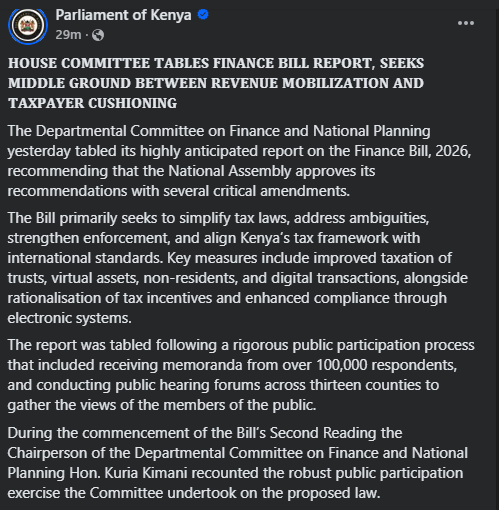
According to the committee, the Finance Bill seeks to simplify tax laws, close loopholes, strengthen compliance mechanisms, and align Kenya’s tax framework with international standards. The proposed law contains measures targeting the taxation of trusts, digital transactions, virtual assets, non-residents, and tax incentives.
While tabling the report, Kimani said the committee was guided by the need to mobilise revenue through administrative reforms without undermining economic recovery, business growth, and taxpayer rights.
“Throughout this process, the Committee was guided by the need to balance revenue mobilisation through administrative reforms with the imperative to support economic recovery, safeguard taxpayers’ rights and promote sustainable growth,” Kuria stated.
One of the key recommendations is the rejection of a proposal that would have allowed the Kenya Revenue Authority (KRA) to issue agency notices while tax disputes, objections, or court cases are still active. The committee argued that such powers could disrupt business operations, strain cash flows, and infringe on taxpayers’ constitutional rights to fair administrative action.
The committee also opposed plans to include weekends and public holidays in the computation of timelines for filing tax objections and appeals, noting that the change would significantly reduce the time available for taxpayers to comply with procedural requirements.
Businesses received further relief after lawmakers rejected the proposed 60 per cent minimum deemed dividend distribution threshold on undistributed income. Stakeholders had argued that the threshold would limit companies’ ability to reinvest profits and expand operations. The committee instead recommended a lower threshold, which will be introduced through amendments during consideration of the bill.
In another taxpayer-friendly move, the committee proposed extending annual tax return filing periods to four months for individuals and six months for corporate entities.
Push for Zero-rated VAT
The report also seeks to shield manufacturers and consumers from higher costs by retaining the zero-rated Value Added Tax (VAT) status on several products. These include locally assembled mobile phones, electric motorcycles, bicycles, buses, solar and lithium-ion batteries, sugarcane transportation services, and raw materials used in animal feed production.
Lawmakers warned that changing the items from zero-rated to VAT-exempt would increase production costs, discourage investment in green technologies, and create uncertainty within the tax regime.
The committee further rejected a proposal to shift the excise duty tax point for mobile phones to the point of network activation, citing implementation difficulties and possible confusion among consumers.
However, while cushioning taxpayers, the committee supported several revenue-enhancing measures. These include the introduction of a 1.5 per cent withholding tax on scrap metal sales to improve traceability in the largely informal sector and new compliance requirements for non-resident landlords earning rental income in Kenya.
The committee also backed a one-year tax amnesty programme beginning July 1, 2026. Under the proposal, penalties and interest accrued up to December 31, 2025, will be waived if taxpayers settle the principal tax by June 2027.

The recommendation draws from the success of the 2023 tax amnesty programme, which generated Ksh43.9 billion from more than one million applicants.
Kimani cautioned that repeated tax amnesties could encourage taxpayers to delay payments in anticipation of future waivers, potentially weakening voluntary tax compliance.
To strengthen enforcement after the amnesty period, the committee recommended amendments to the Tax Procedures Act that would give KRA expanded debt recovery powers for fees and levies collected on behalf of other government agencies.
The report now forms the basis of ongoing debate in the National Assembly, with lawmakers expected to consider the proposed amendments before the Finance Bill 2026 proceeds to the next stage of the legislative process.